Colombian Birth Certificate Guide: Copies, Apostille & Translation
Colombian Civil Birth Registry Guide
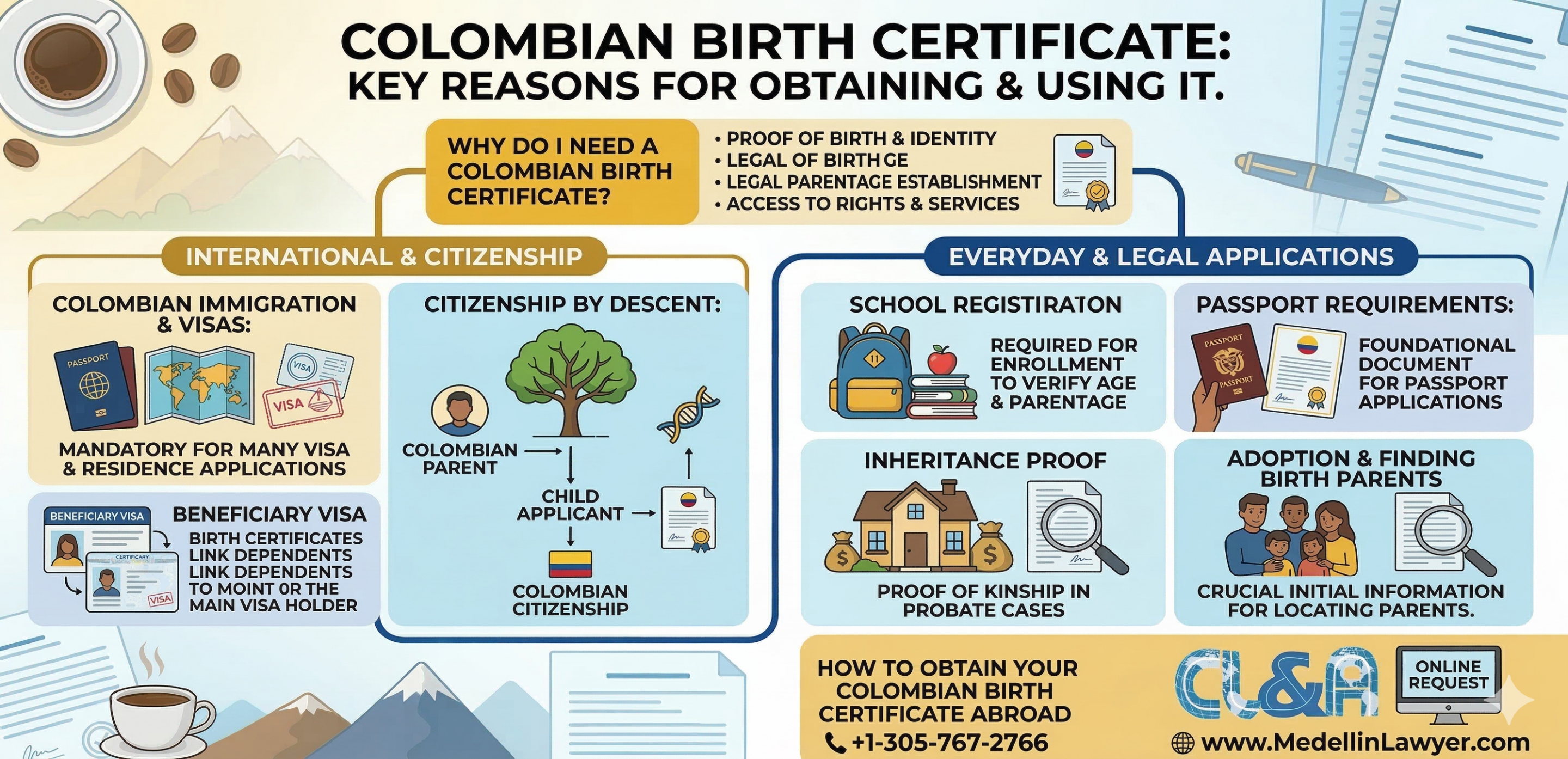
A Colombian birth certificate is often needed long before a family expects it. For expats living in Colombia and Colombians living abroad, this document may become central to immigration filings, citizenship procedures, school enrollment, inheritance matters, passport applications, marriage or divorce proceedings, and other cross-border legal processes. The practical issue is usually not only obtaining a copy, but obtaining the correct certified version and preparing it properly for use in Colombia or abroad.
Featured definition. A Colombian birth certificate, or registro civil de nacimiento, is the official civil-registry record that proves a person’s birth, identity linkage, and parentage within Colombia’s civil-status system. In practice, the document used in legal and administrative procedures is usually a certified registry copy issued by the competent registry authority or the office where the original inscription was made.
| Common Situations Where a Colombian Birth Certificate Is Required | Typical Users | Why the Certificate Is Needed |
|---|---|---|
| Applying for residency or citizenship outside Colombia | Colombians living overseas or relocating abroad | Foreign immigration authorities often require a certified birth certificate, usually with apostille and translation. |
| Repatriation or claiming Colombian citizenship | Children of Colombians born abroad, returning nationals | The civil registry helps prove Colombian parentage and may support nationality registration. |
| Retirement or pension benefit applications | Colombians residing outside Colombia | Government agencies may request birth records to confirm identity, age, and eligibility. |
| Immigration or citizenship applications | Colombians applying for foreign visas or citizenship | Birth certificates are frequently required to establish identity and family relationships. |
| Succession and inheritance processes | Families handling estates in Colombia or abroad | The document helps prove family relationships necessary for inheritance proceedings. |
| School registration, especially for minors | Expat families living in Colombia | Schools may request a birth certificate to confirm identity and parental relationship. |
| Marriage or divorce proceedings | Foreign residents or Colombian nationals | Notaries and courts may require civil registry documentation when processing civil-status changes. |
| Applying for a new passport | Colombian nationals in Colombia or abroad | The birth certificate may be used to confirm identity when applying for or replacing passports. |
Who typically needs this article?
Expats living in Colombia often need a Colombian birth certificate when registering a child, enrolling a minor in school, getting married before a Colombian notary, filing a family-based visa, or preparing for divorce, custody, or inheritance proceedings. In these cases, the certificate is usually part of a broader Colombian civil-status or immigration file rather than a standalone document request.
Colombians living abroad often need a fresh certified copy when applying for residency, citizenship, pension or retirement benefits, a passport, inheritance procedures, or family-based immigration abroad. In practice, these users are usually not looking only for the certificate itself; they also need the correct downstream workflow, which may include apostille, official translation, and coordination with a foreign authority.
Related Topics of Interest for You:


What legal processes commonly require a Colombian birth certificate?
- Applying for residency or citizenship outside Colombia
- Repatriation or reclaiming Colombian citizenship
- Retirement or pension benefit applications
- Immigration applications and family-based filings
- Citizenship applications abroad
- Succession and inheritance proceedings
- School registration, especially for minors
- Marriage and divorce proceedings
- Applying for a new passport
- Identity and parentage verification in cross-border matters
Typical workflow when a birth certificate will be used internationally
- Obtain a fresh certified copy of the civil registry record.
- Confirm which authority issued the document: Registraduría or a notary.
- Request apostille authentication through the appropriate Colombian channel.
- Complete an official translation if the destination country does not accept Spanish.
- Submit the authenticated document in the immigration, citizenship, inheritance, or civil process.
On this page
- What is a Colombian birth certificate?
- Why the document matters in real expat cases
- Legal framework and institutional structure
- How birth registration works in Colombia
- How to obtain certified copies
- Current costs and planning numbers
- Apostille and translation workflow
- Common errors, rejection points, and risk control
- Immigration, marriage, inheritance, and cross-border use
- Frequently asked questions
- Official sources and editorial note
What is a Colombian Birth Certificate?
A Colombian birth certificate, formally known as the Registro Civil de Nacimiento, is the official civil-registry record used to confirm a person’s birth, identity, and parentage under Colombia’s civil-status system. Certified copies of this registry entry are commonly required when individuals apply for immigration benefits, citizenship recognition, inheritance procedures, school enrollment, passport issuance, or other legal processes that require verified proof of identity and family relationship.
Why a Colombian Birth Certificate Matters in Practice
For expats and cross-border families, birth certificates become important much earlier than most people expect. They are commonly requested when a child is born in Colombia, when a family is preparing a visa file, when a couple is planning a marriage before a notary, when inheritance rights must be proved, or when a foreign authority wants documentary proof of identity and family relationship. The underlying problem is often not whether the person has a birth record somewhere, but whether the correct civil-registry version is available for the specific legal use.
That distinction matters because civil-status documents are not interchangeable. A scanned image, an outdated informal copy, or a digital certificate that does not meet apostille requirements can delay a filing even when the underlying record is valid. For readers working through broader family-law issues, related pages on family law, custody, marriage, divorce, inheritance, visas, and apostille procedure are part of the same practical document chain.
Legal Framework and Institutional Structure
Colombia’s civil registry operates as a formal public-record system rather than a loose certificate service. The Registraduría explains that the civil registry records the facts tied to identity, filiation, and civil status from birth to death. It also explains that birth registration is the step that recognizes a person’s legal existence and assigns a unique identification number. That institutional description is the most important starting point for this topic because it clarifies that the birth certificate is not merely evidentiary convenience; it is part of the state’s core identity infrastructure.
For practical use, the key authorities differ depending on the stage of the process. Registraduría Nacional del Estado Civil manages birth registration and copy issuance. Authorized registries and original registration offices handle certified-copy requests. Notaries may appear in the chain because some civil registry records are issued there. The Ministry of Foreign Affairs, commonly referred to as Cancillería, is the competent apostille authority for Colombia. This institutional split is why users often get stuck: the real question is not only how to get a birth certificate, but who issued the version in hand and which authority must authenticate the next step.
Operational rule. If the document problem is about the existence of the record, correction of the record, or obtaining a fresh certified copy, the issue normally sits with the registry authority. If the problem is international validity, it usually sits with apostille and translation workflow. If the problem is how the certificate will be used in a larger family or immigration matter, the correct analysis starts with the downstream legal process.
How Birth Registration Works in Colombia
The Registraduría explains that registering a birth recognizes the person’s legal existence and individualizes that person with a name and unique identification number. It also states that the registration should ordinarily be completed within the month following birth, after which the registration is treated as extemporaneous. That timing point is not academic. Late registrations frequently create the same kind of evidentiary friction that later appears in parent visas, nationality matters, school files, custody disputes, and inheritance proceedings.
The same official guidance identifies the supporting documents and substitutes that may be used depending on the case. In ordinary hospital births, the standard antecedent document is the certificado de nacido vivo. In more complex situations, the system contemplates authentic identity or judicial documents, community-based authorizations in certain indigenous contexts, baptismal records with competence certification, ICBF resolutions, special resolutions for unknown-parent cases, foreign civil records that are apostilled or legalized and translated when the birth occurred abroad, authorized midwife forms, or sworn testimony from two witnesses when no prior document exists.
| Registration Point | What the Official Source Says | Why It Matters in Practice |
|---|---|---|
| Purpose of birth registration | Recognizes legal existence and assigns a unique identification number | The birth record becomes the base civil-status document for later filings |
| Ordinary deadline | Within one month after birth | Late filing can increase documentary scrutiny later |
| Main antecedent document | Certificate of live birth | Most routine cases should start with the medical birth document |
| Fallback evidence | Multiple substitutes including witnesses where no prior record exists | Useful in historical, rural, or incomplete-document cases |
| Birth abroad | Foreign civil record must be apostilled or legalized and translated | Critical for nationality and parentage chains tied to foreign births |


For foreign parents and mixed-nationality families, the civil registry entry often becomes the foundation for later visa filings, school records, passport coordination, and citizenship analysis. That is why it is useful to think about the birth certificate not as a single document request but as the first link in a broader proof chain.
How to Obtain Certified Copies of a Colombian Birth Certificate
The official copy-issuance guidance is clear on the baseline rule: copies of birth, marriage, and death registrations that serve to prove acts relating to civil status may be requested in person at authorized registries nationwide or at the office where the original inscription was made. This matters because many users assume there is a single national pickup point. In practice, the route depends on where the original inscription lives and whether the particular record is consultable outside that office.
The official source also notes that applicants should be prepared to provide identifying registration data such as names and registry details, and that older tomo y folio records may only be consultable in the office where they were originally inscribed. That point is especially important in older family records, rural registrations, succession matters, or cases where the family does not have a clean serial reference.
- Identify whether the record is modern and easily traceable or an older tomo y folio inscription.
- Gather the identifying information available: names, date of inscription, serial, folio, or tomo if known.
- Determine whether the best route is the original office or an authorized registry near the applicant’s location.
- Pay the official copy fee through the accepted channel.
- Review the issued copy immediately for names, dates, parent information, notes, signatures, and issuing authority.
- If the certificate will be used abroad, confirm before translating whether apostille must be requested through Registraduría or directly through Cancillería because the issuing office matters.
Important exception. Registry copies containing sensitive data, such as adoption-related information or certain special annotations, are not freely available to any requester. Access may be limited to the holder, legal successors, legal representatives, public entities acting within legal authority, or authorized third parties.
Current Copy and Apostille Costs
Current official pricing provides useful planning numbers but should not be treated as the full cost of a complete international-use file. In addition to the official copy fee and apostille fee, families often need translations, courier handling, or document coordination. That is especially true when a birth certificate is only one piece of a larger residency, inheritance, or citizenship process.
| Item | Current Reference Amount | Planning Note |
|---|---|---|
| Physical registry copy | COP 10,800 | Applies to copy issuance under the Registraduría tariff schedule |
| Online registry copy | COP 18,750 | Not every online version is suitable for every downstream use |
| Apostille | COP 36,000 | HCCH practical information amount for Colombia’s competent authority |

Apostille and Translation Workflow
The apostille stage is where many otherwise valid birth certificates fail operationally. The Registraduría apostille guidance explains that, for its own channel, the civil registry must be submitted in PDF, the payment evidence must be visible, the record must have been issued recently, it must include the signature, name, and position of the issuing official, and both sides must be fully digitized. The same guidance also explains that digital certificates are not accepted for apostille through that route because they do not contain the notes space needed for special procedures. It further indicates that when the civil registry was issued by a notary rather than the Registraduría, the user must process the apostille through Cancillería.
This aligns with the practical order-of-operations problem many users face: Colombia apostilles Colombian-origin public documents; foreign documents must be apostilled or legalized in their own country of origin; and translation normally follows apostille unless the receiving authority explicitly requires a different sequence. Many rejections happen not because the record is invalid, but because the right steps were performed in the wrong order.
| Scenario | Normal Workflow | Why the Workflow Changes |
|---|---|---|
| Colombian birth certificate issued by Registraduría, for foreign use | Fresh certified copy → apostille request → official translation if required | Registraduría sets its own intake rules for records it issued |
| Colombian birth certificate issued by a notary | Obtain proper notarial copy → process through Cancillería | Notary-issued records follow the Cancillería route |
| Foreign birth record for use in Colombia | Apostille or legalization in country of origin → official Spanish translation if needed | Colombia does not apostille foreign-origin documents |


Official Sources and Editorial Note
This page is structured as a full authority article rather than a thin service page. It preserves the real user intent behind the topic, including document retrieval, apostille, translation, immigration use, citizenship analysis, and family-law relevance, while grounding the procedural portions in official institutional materials.
- Registraduría: Registro civil
- Registraduría: Registro de nacimiento
- Registraduría: Expedición de copias de registro civil
- Registraduría: Tarifas vigentes
- Registraduría: Apostilla del registro civil
- Cancillería: Apostilla y legalización
- Cancillería: Nacionalidad
- Cancillería: Pasaportes
- HCCH: Colombia competent authority for apostille
- Medellin Lawyer: About Us
- Medellin Lawyer: Contact Us
Editorial note: official confirmation was used where available. Unsupported marketing claims were intentionally excluded.

Colombia’s apostille system is administered by the Ministry of Foreign Affairs, and users should verify current requirements through the official Cancillería apostille channel before submitting a record for international use.
Common Mistakes and Rejection Points
The practical problems around birth certificates usually fall into a few recurring categories. The first is using the wrong document version. A person may have a valid online certificate for one purpose but still need a fresh physical registry copy for apostille. The second is timing. Recently issued civil-status records are often required, and certain apostille routes impose their own recency limits. The third is source confusion: the user does not distinguish between a certificate issued by Registraduría and one issued by a notary, so the authentication request begins in the wrong place.
Another frequent problem is inconsistency across the civil-status chain. Parent names, identification numbers, annotations, or serial references may not match related documents. That becomes especially important in immigration and inheritance settings, where the quality of the proof chain can determine whether a filing moves smoothly or stalls. A final mistake is overgeneralization. A birth certificate is not a one-size-fits-all document. The receiving authority may be checking civil status, identity, parentage, nationality context, or mere authenticity. The correct strategy depends on the legal use case.
- Do not assume a digital copy can be apostilled through the same route as a physical registry copy.
- Do not translate first without checking whether the receiving authority expects apostille on the original record first.
- Do not submit an older or annotated certificate without confirming whether supporting background records are needed.
- Do not rely on family memory alone for older tomo y folio records; identify the original office early.
- Do not treat a birth-certificate problem as only a translation issue when the real issue is registry correction or proof-chain inconsistency.
Where This Document Fits in Marriage, Visas, Inheritance, and U.S. Cases
Birth certificates appear in several recurring clusters of cross-border legal work. One clear cluster is marriage planning. Foreign couples often discover that the problem is not whether Colombia allows the marriage, but whether their civil-status documents are notary-ready. Another cluster is family-based immigration. A Colombian birth certificate may be central in parent-child relationship files, beneficiary visa filings, nationality claims, and dependent applications. A third cluster is family conflict and succession, where the birth certificate becomes evidence linking people to each other in divorce, custody, and inheritance matters.
The same document also appears regularly in U.S.-bound or other foreign immigration processes. In those settings, the relevant question is usually not only whether the Colombian document exists, but whether the receiving foreign authority will accept it in its current form. That is why the apostille, translation, and proof-chain analysis in this article matters for readers who are preparing documents for use outside Colombia.
Recommended Internal-Link Architecture for This Page
- About Us
- Contact Us
- Colombia Translations & Apostilles
- Official Colombian Translations
- Certified Translations in Colombia
- How to Get Married in Colombia
- Colombian Marriage Visa
- Colombia Parent Visa
- Colombian Beneficiary Visa
- Colombia Visas
- Colombian Residency Guide
- Colombia Permanent Residency
- Cédula de Extranjería Guide
- Colombian Family Law for Foreigners
- Colombia Child Custody for Expats
- How to Divorce in Colombia
- How to Plan for Divorce in Colombia
- Prenuptial Agreement in Colombia
- Colombian Power of Attorney
- Colombian Will and Estate Planning for Foreigners
- What Happens if My Visa Application Is Rejected?
- How to Get a Fiancée Visa for the United States
- What Happens if My Visa Application Is Rejected?
- How to Get a Fiancée Visa for the United States
Frequently Asked Questions
Why do I need a copy of my Colombian birth certificate?
A certified Colombian birth certificate is frequently required to prove identity and family relationships in legal and administrative processes. Authorities may request the document when verifying parentage, confirming nationality eligibility, or establishing legal identity in immigration, inheritance, school, passport, or civil-status proceedings.
Do immigration applications require a Colombian birth certificate?
Many immigration processes require birth certificates to verify identity and family relationships. This commonly occurs in family-based visa applications, nationality claims, and residency filings where the applicant must prove parent-child relationships or nationality eligibility.
Is a birth certificate required for the Colombian beneficiary visa?
Yes. The beneficiary visa process typically requires proof of the family relationship between the principal visa holder and the dependent applicant. A Colombian birth certificate may be used to demonstrate the parent-child relationship when minors apply as beneficiaries.
Can a Colombian birth certificate be used to reclaim Colombian citizenship?
In many situations, individuals born to Colombian parents abroad may use their birth certificate as part of the documentation proving eligibility for Colombian nationality registration. Additional documents may be required depending on the specific case and registry history.
Do schools in Colombia require a birth certificate?
Educational institutions frequently request birth certificates during school registration, particularly for minors. The document confirms the student’s identity, age, and parental relationship for enrollment and administrative records.
Is a birth certificate needed for inheritance or succession processes?
Yes. Inheritance and succession procedures often require civil-registry documentation to verify family relationships between the deceased and potential heirs. Birth certificates may serve as key evidence linking family members in succession filings.
Do you need a birth certificate to obtain a Colombian passport?
Birth certificates may be used to verify identity and civil status when applying for or renewing a Colombian passport, particularly when other identity documentation is unavailable or when identity verification is required.
Can a birth certificate help locate biological parents?
Civil-registry records may contain information about parents or guardians recorded at the time of birth. However, additional administrative or legal procedures may be required when individuals attempt to identify biological parents or access restricted records.
Can Colombians living abroad request a birth certificate?
Yes. Colombians living abroad may obtain certified copies through authorized civil-registry offices or through representatives in Colombia, and the resulting document may then be apostilled and translated if required for foreign use.
How recent must a birth certificate be for apostille?
For the Registraduría apostille route, the certificate is typically expected to be recently issued and must include the issuing-authority details required for authentication. Users should confirm current requirements before filing because process rules can vary by issuing authority.
How can I get a Colombian birth certificate if I live outside Colombia?
A common route is to request a certified copy through an authorized representative in Colombia or through the office where the birth was recorded, then complete apostille and translation if the document will be used abroad.
What if my Colombian birth certificate contains an error?
If a civil-registry entry contains incorrect information, such as spelling errors, incorrect parent identification numbers, or inaccurate birth details, the record may need a correction procedure. Depending on the nature of the issue, the correction may be handled administratively or may require additional supporting documentation.
Can I replace a lost Colombian birth certificate?
Yes. Because the birth record remains stored in the civil-registry system, individuals can request new certified copies if a prior copy is lost or damaged. The replacement copy carries the same operative legal value as any other properly issued certified copy.

What Clients Say About Colombia Legal & Associates
⭐️⭐️⭐️⭐️⭐️ 4.7 out of 5.0 based on Google reviews for Colombia Legal & Associates S.A.S.
Public feedback from clients who worked with our legal team on Colombian visa and related legal matters.
Reviews are sourced from publicly available third-party platforms. Individual results may vary.
“I worked with the Medellín team and had an excellent experience. Once I was connected with Isabela, I felt confident I was on the right path to obtaining my visa.”
— Mathew Sickler
“The team helped significantly with my visa process, and everything went much smoother than expected.”
— Mohan Chander Narasimman
“This is the company to use for visa services. My experience was excellent and well organized.”
— Benjamin
“Professional and responsive. They provided clear guidance and helped me understand the process from start to finish.”
— Robert Nepon
“Very professional service. Everything was clearly explained, which helped me avoid delays.”
— Reynaldo Araujo
“Clear communication and realistic expectations. Helpful for someone unfamiliar with Colombian legal procedures.”
— Justin Halladay
Important Legal Disclaimer
The information provided on this website is for general informational purposes only and does not constitute legal advice, immigration advice, tax advice, or a guarantee of any specific outcome.
Colombian laws, visa requirements, administrative criteria, government fees, and procedures change frequently and may be updated without notice. Information published on this site may become outdated or incomplete over time.
Reading or using this website does not create an attorney–client relationship with Colombia Legal & Associates S.A.S., MedellinLawyer.com, or any member of our team.
We strongly recommend consulting directly with qualified legal or accounting professionals regarding your specific immigration, tax, or compliance needs before taking action.
Other Related Services We Offer: