
How to Get Married in Colombia for Foreigners and Expats (2026 Legal Guide)
Getting married in Colombia as a foreigner is often simpler than people expect—until the paperwork starts. Most delays do not happen because Colombia “doesn’t allow” foreigners to marry. They happen because couples arrive with documents that are technically correct in their home country, but not prepared in the format a Colombian notary can accept.
This guide explains the real-world notary workflow, the document and translation rules that cause delays, how to secure the civil registry document after the ceremony, and how marriage connects to visas, property planning, and long-term legal stability for expats. Official background on the civil marriage procedure: MinJusticia – Civil marriage procedure
Quick answers for expats (fast legal clarity)
Most couples get delayed for the same predictable reasons. Here’s what matters most:
- Most couples marry at a Notaría (civil marriage), then rely on the registro civil afterward.
- The #1 delay trigger is foreign paperwork missing apostille/legalization and/or a certified Spanish translation.
- Many procedures require “recent” civil documents (often measured in months). For visa filings, Cancillería commonly requires registry documents issued within 3 months.
- The ceremony is not the finish line—the registro civil de matrimonio is usually the key proof document for future steps.

Want a predictable timeline (and fewer notary surprises)?
The fastest way to reduce delays is to prepare a notary-ready file first—apostille/legalization + certified translations + clean civil status proof— and then file strategically. If you’re still gathering documents, start with: Colombia Translations & Apostilles and our family-law hub: Colombian Family Law (for foreigners).

Click Here to Download Infographic
Marriage options in Colombia: civil, religious with civil effects, and civil union
Your original page correctly noted that couples can formalize relationships in different ways in Colombia. For most foreigners, the most common route is a civil marriage at a Notaría. But it is not the only route.
Option 1: Civil marriage (most common for expats)
A civil marriage is typically celebrated before a notary (and in some cases before a judge). After the marriage act,
the marriage is registered so you can obtain the civil registry record.
See: MinJusticia – civil marriage procedure
and Registraduría – registro civil de matrimonio.
Option 2: Religious marriage with civil effects
Colombia’s civil registry recognizes marriages celebrated through religious rites when properly registered. Registraduría explains that the civil registry serves as proof of marriage whether the marriage was celebrated through a religious rite or before a civil authority.
Registraduría – religious rite and civil authority marriages
Option 3: Civil union (unión marital de hecho)
A civil union is not the same legal act as marriage, but it can be relevant for family-law and immigration strategy in certain cases. If you are deciding between marriage and civil union, start with: What is a Civil Union in Colombia?
Note: Same-sex marriage is permitted in Colombia, and the practical notary workflow is generally similar for all couples (document compliance remains the core bottleneck).
Related Topics of Interest for You:


Who can legally marry in Colombia?
In general, foreigners can marry in Colombia through the civil marriage procedure. What matters most is whether the notary can confirm: identity, civil status, and legal capacity to marry. When couples get stuck, it’s rarely because a rule prohibits them; it’s because the proof is incomplete, inconsistent, or not presented in the format the notary needs. Government overview: MinJusticia – Civil marriage procedure.
What the notary is actually checking
A Colombian notary is not “approving” your relationship. They are verifying legal requirements and whether your documents prove them. In most expat cases, the notary is effectively auditing this chain: Identity → Birth record → Current civil status → Prior marriage termination (if applicable) → Translation + apostille/legalization (if applicable).
This is why the same couple can have two very different experiences depending on preparation. Couples who assemble a clean proof packet first often experience a predictable timeline. Couples who file early and correct documents later often get stuck in a repeat loop.
Notary marriage process in Colombia (step-by-step, written like a real case)
The overall process is simple. The details are where expats lose time. Here’s the typical flow most couples follow when marrying at a Notaría:
Step 1: Choose the notary and confirm format requirements
Notaries follow the same legal logic, but requirements can vary by notary and by case details. Before you spend money reissuing paperwork, confirm what that notary expects (especially for foreign certificates and translations).
Step 2: Build your proof packet before you file
The safest approach is to build a single proof packet that includes key civil documents, their apostilles/legalizations (if required), and their Spanish translations. If you are still collecting apostilles/translations, start here: Colombia Translations & Apostilles.
Step 3: File the request and complete notary review
Filing is a formal request with evidence. The notary reviews completeness and may request clarification (for example,
inconsistent name spelling, missing pages on decrees, or apostille/translation mismatches).
Step 4: Ceremony and signing
The ceremony is usually not the hard part. If a spouse is not fluent in Spanish, some notaries may require an interpreter to ensure informed consent. (This protects legal validity.)
Step 5: Secure the civil registry outcome document
The document that matters most after the ceremony is often the registro civil de matrimonio. Official reference: Registraduría – Registro civil de matrimonio.


Documents required to get married in Colombia (foreigner checklist + practical guidance)
The official requirement logic is straightforward: prove identity and civil status. In real life, notary practice and international document formats create friction.
The U.S. Embassy notes that notaries commonly require certified birth certificate copies. U.S. Embassy – Marriage in Colombia One important detail from your original page is worth keeping: in practice, notaries often expect “recently issued” civil certificates (commonly measured in months).
For many Colombia processes, “3 months / 90 days” is a frequent standard for fresh civil registry documents; and for visas, Cancillería requires certain registry documents to be issued within 3 months. Cancillería – Visa M (Cónyuge)
Core documents (most foreign spouses)
Your file should tell a clean story. If your passport says “John A. Smith” but your birth certificate says “John Andrew Smith,” don’t assume the notary will “figure it out.” Your documents should match or be supported with clarifying evidence.
- Valid passport (and any Colombian ID you already have, if applicable)
- Birth certificate issued by your home jurisdiction (often required as a certified copy)
- Proof of civil status (single / divorced / widowed) as applicable
- Proof that prior marriages ended (divorce decree or death certificate), if applicable
- Apostille or legalization (when required for foreign-issued documents)
- Certified Spanish translations (when documents are not in Spanish)
If you need document compliance support, these internal resources are designed for exactly this step: Colombia Translations & Apostilles, Certified Translations in Colombia, and Official Translations.
Real-world example (why couples get delayed)
A common scenario: a foreign spouse brings a birth certificate and a divorce decree, but the divorce decree is missing the final page, or the apostille was issued for a different certified copy than the one translated. The notary doesn’t “deny” the marriage; the notary simply refuses to schedule until the chain is corrected.
Want documents accepted the first time?
The fastest timeline is usually created before you contact the notary: apostille/legalization completed, certified translations done, and names/dates consistent across documents. Start with: Translations & Apostilles.


Apostille/legalization + certified translation rules (the #1 expat bottleneck)
If your documents were issued outside Colombia, they often need either an apostille or legalization (depending on the issuing country).
And if they are not in Spanish, they usually need a Spanish translation that meets the standard the notary accepts.
Useful official reference on apostille/translation expectations (in the context of recognition/registry processes): MinJusticia – validity in Colombia of a marriage celebrated abroad
Best practice: a single proof packet
Treat your file like a compliance packet: consistent names, clear seals, correct apostille attachment, and translations tied to the correct underlying certified copy. One mismatch can trigger a reissue/retranslation cycle.
After the ceremony: civil registry and legal recognition
The most valuable outcome document is often the registro civil de matrimonio. Registraduría explains that registration provides publicity and proof of the marriage, whether celebrated via religious rite or before a civil authority (judge or notary). Registraduría – Registro civil de matrimonio
For Cancillería’s civil registry guidance (especially relevant for consular contexts), see: Cancillería – Registro civil de matrimonio
Special cases foreigners should plan early
Marriage celebrated outside Colombia
If your marriage happened abroad and you want it recognized in Colombia, you generally register it through the civil registry route using an apostilled/legalized marriage certificate and translation when required. MinJusticia – foreign marriage recognition
If you married in a church or religious ceremony
Religious marriages can be registered for civil effects. Registraduría explains that the civil registry proves the existence of marriage whether celebrated via religious rite or civil authority. Registraduría – registry for religious marriages
Two foreigners marrying in Colombia
Depending on nationality and facts, some couples explore alternative routes. See MinJusticia’s discussion of marriages celebrated before accredited diplomatic/consular representatives in Colombia: MinJusticia – diplomatic/consular marriages
Previously married (divorce planning)
If either spouse was previously married, plan for complete proof that the prior marriage ended (divorce decree or death certificate), and ensure apostille/legalization and translation are handled properly.
Helpful internal guides: How to Divorce in Colombia and How to Plan for Divorce in Colombia.
Key marriage-law issues expats miss (assets, minors, community property, prenups)
Your original page highlighted several “non-obvious” issues that matter for foreigners: minors, asset inventory, and how marital property can be treated. These issues often don’t show up until you try to marry quickly or when a notary flags that a judicial step is needed before the marriage can proceed.
Inventory of assets when minors are involved
If one spouse has minor children, your original content correctly warned that an asset inventory step may be required before marriage in some situations. Practically, this is a “do it early” item because it can slow timelines if discovered late.
Community property expectations (practical reality for expats)
Your original page emphasized Colombia’s community-property concept. In practice, marriage and recognized unions can affect property, inheritance planning, and dispute exposure. If assets, businesses, or future property purchases are involved, planning early is smarter than fixing disputes later.
Prenuptial agreements (capitulaciones)
If you want to clarify asset separation or protect existing property, consider a prenuptial strategy before marriage: Colombian Prenuptial
Symbolic ceremonies
Your original page mentioned symbolic ceremonies. A symbolic ceremony can be meaningful culturally, but it is not automatically the civil act.
If the goal is legal recognition, plan the civil notary/registry steps as the legal foundation. Related planning guides: How to Buy Real Estate in Colombia | Colombia Property Title Law | Will & Estate Planning in Colombia
Timelines, “recent documents,” and the delays you can prevent
Couples often ask: “How long does it take to get married in Colombia?” The honest answer is: it depends on document readiness and notary workflow. Your original page referenced the “posting period” concept as part of civil notary timelines; treat this as part of the notary’s process scheduling.
“Recent documents” is a real rule in practice
Notaries frequently request recently issued civil certificates (often within months). For immigration filings, Cancillería explicitly requires certain registry documents issued within the last 3 months for the spouse visa category. Cancillería – Visa M (Cónyuge)
Common delays expats can prevent
- Inconsistent name spelling across passport vs. birth certificate vs. divorce documents
- Apostille/legalization missing or attached incorrectly
- Translations that do not meet the notary’s accepted standard
- Incomplete prior marital status proof (missing pages, unclear finality, unclear seals)
Visa next steps after marriage (and civil union alternatives)
Marriage does not automatically grant a visa, but the civil registry document is commonly a foundation for spouse-based filings. Official spouse visa page: Cancillería – Visa M (Cónyuge)
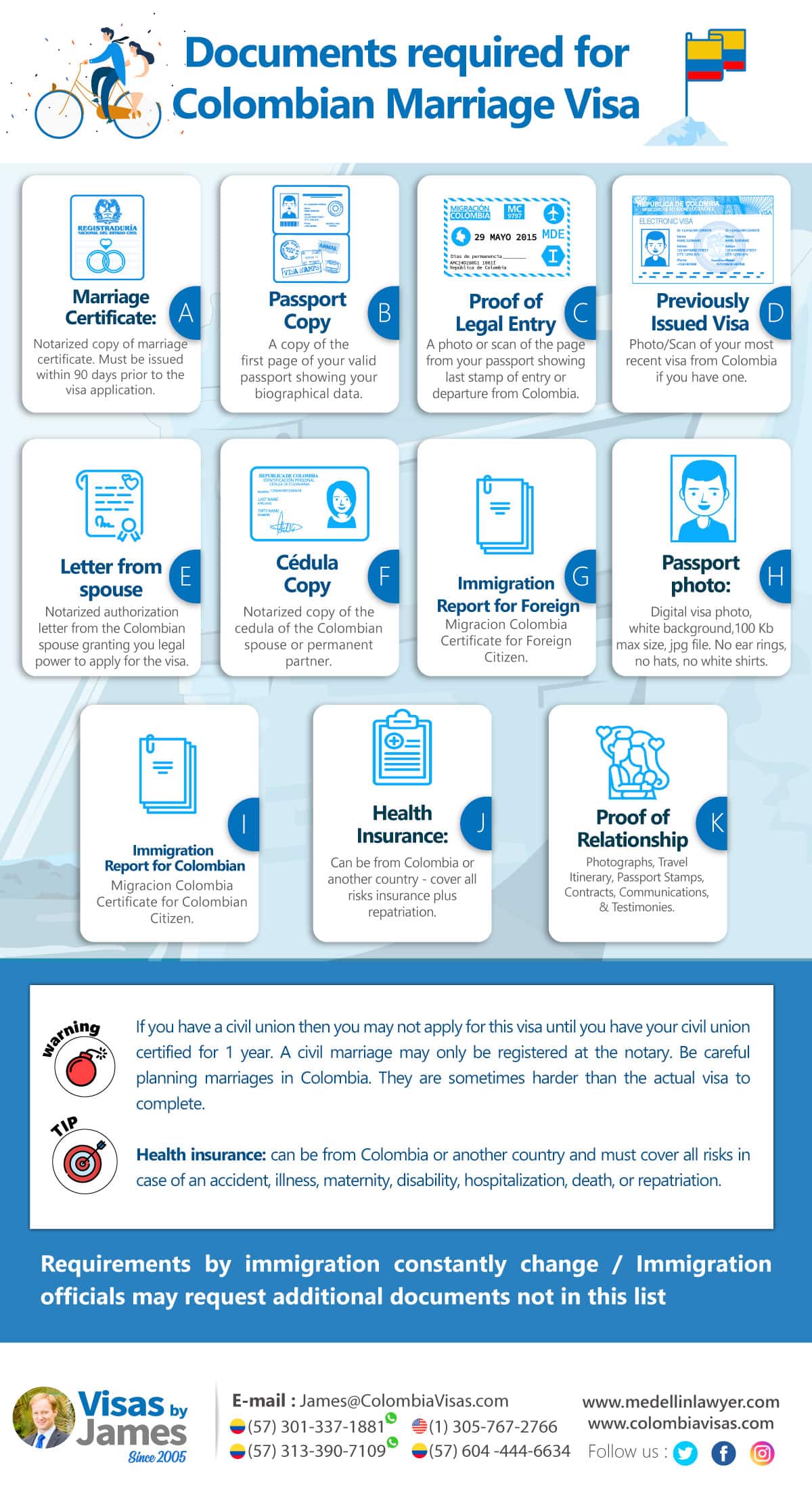
Marriage visa documentation (high-level checklist)
Your original page included a document list for marriage visa cases. Requirements can change and vary by case, so the safest approach is to anchor to Cancillería.
At a high level, spouse visa packages commonly involve identity, immigration status, relationship proof, and the marriage civil registry record (often required within 3 months of issuance).
Cancillería – spouse visa requirements (includes 3-month registry issuance rule)
- Passport copy and compliance with entry/immigration status requirements
- Authentic copy of the Colombian marriage civil registry record (often issued within 3 months)
- Supporting letter(s) and identity document(s) for the Colombian spouse (as applicable)
- Additional supporting evidence depending on case specifics
If you are not married: civil union visa path
For couples using the civil-union route with a Colombian national, see the official category: Cancillería – Visa M (Compañero[a] permanente)
Related internal visa guides
- What is a Colombian Marriage Visa?
- What is the Colombian Beneficiary Visa?
- Colombia Visa Guide
- All Colombian Visas
U.S. immigration (if your plan includes the United States)
If your case involves U.S. immigration pathways, see:
How to Get a Fiancée Visa for the United States Broader expat visa information (allowed external): ColombiaVisas.com
FAQ: Getting married in Colombia (foreigners and expats)
Can foreigners get married in Colombia while visiting?
In many cases, yes, but outcomes depend on the notary’s review of identity and civil status proof. The practical bottleneck is usually document compliance: apostille/legalization and certified Spanish translation where required.
Do religious marriages “count” in Colombia?
The civil registry provides proof of marriage whether it was celebrated via religious rite or before a civil authority (judge or notary), once properly registered. Registraduría – Registro civil de matrimonio
Should we sign a prenuptial agreement?
If you want to clarify property rights or protect assets, consider planning a prenuptial agreement before marriage. See: Colombian Prenuptial.
Do I need a birth certificate?
Most notaries require a birth certificate (often a certified copy). If it is foreign and not in Spanish, plan for apostille/legalization and a certified Spanish translation.
U.S. Embassy – Marriage in Colombia
Does getting married automatically give me a Colombian visa?
No. You must apply for the relevant visa category through Cancillería. For the spouse category: Cancillería – Visa M (Cónyuge)

Next step: make your case predictable
If you want a predictable timeline, focus on document compliance first, then file strategically with the notary, then secure the civil registry document for visa/legal steps.
Start here: Translations & Apostilles | Family Law for Expats | Marriage Visa


What Clients Say About Colombia Legal & Associates
⭐️⭐️⭐️⭐️⭐️ 4.7 out of 5.0 based on Google reviews for Colombia Legal & Associates S.A.S.
Public feedback from clients who worked with our legal team on Colombian visa and related legal matters.
Reviews are sourced from publicly available third-party platforms. Individual results may vary.
“I worked with the Medellín team and had an excellent experience. Once I was connected with Isabela, I felt confident I was on the right path to obtaining my visa.”
— Mathew Sickler
“The team helped significantly with my visa process, and everything went much smoother than expected.”
— Mohan Chander Narasimman
“This is the company to use for visa services. My experience was excellent and well organized.”
— Benjamin
“Professional and responsive. They provided clear guidance and helped me understand the process from start to finish.”
— Robert Nepon
“Very professional service. Everything was clearly explained, which helped me avoid delays.”
— Reynaldo Araujo
“Clear communication and realistic expectations. Helpful for someone unfamiliar with Colombian legal procedures.”
— Justin Halladay
Important Legal Disclaimer
The information provided on this website is for general informational purposes only and does not constitute legal advice, immigration advice, tax advice, or a guarantee of any specific outcome.
Colombian laws, visa requirements, administrative criteria, government fees, and procedures change frequently and may be updated without notice. Information published on this site may become outdated or incomplete over time.
Reading or using this website does not create an attorney–client relationship with Colombia Legal & Associates S.A.S., MedellinLawyer.com, or any member of our team.
We strongly recommend consulting directly with qualified legal or accounting professionals regarding your specific immigration, tax, or compliance needs before taking action.
Other Related Services We Offer:

Colombian Prenuptial

Colombia Birth Certificate
Colombian Civil Law