
Your Essential Guide: Filing Colombian Tax Declarations as a Foreigner
Moving to a new country often brings a wave of exciting opportunities, but it also introduces new responsibilities, especially when it comes to financial matters. For many foreigners and expats settling in Colombia, understanding the local tax system can feel like navigating a complex labyrinth. This guide is designed to demystify the process of filing Colombian tax declarations for individual taxpayers. We will break down key concepts, outline your tax obligations, and provide a clear roadmap to ensure compliance, giving you peace of mind as you enjoy your life in this vibrant country. Understanding your Colombian tax obligations is paramount for responsible financial planning and avoiding potential legal repercussions. As Colombia’s tax system has evolved, staying informed about your duties, especially regarding income tax and tax residency, is crucial for both long-term residents and those spending significant time in the country.

Related Topics of Interest for You:


The Importance of Understanding Your Tax Obligations in Colombia
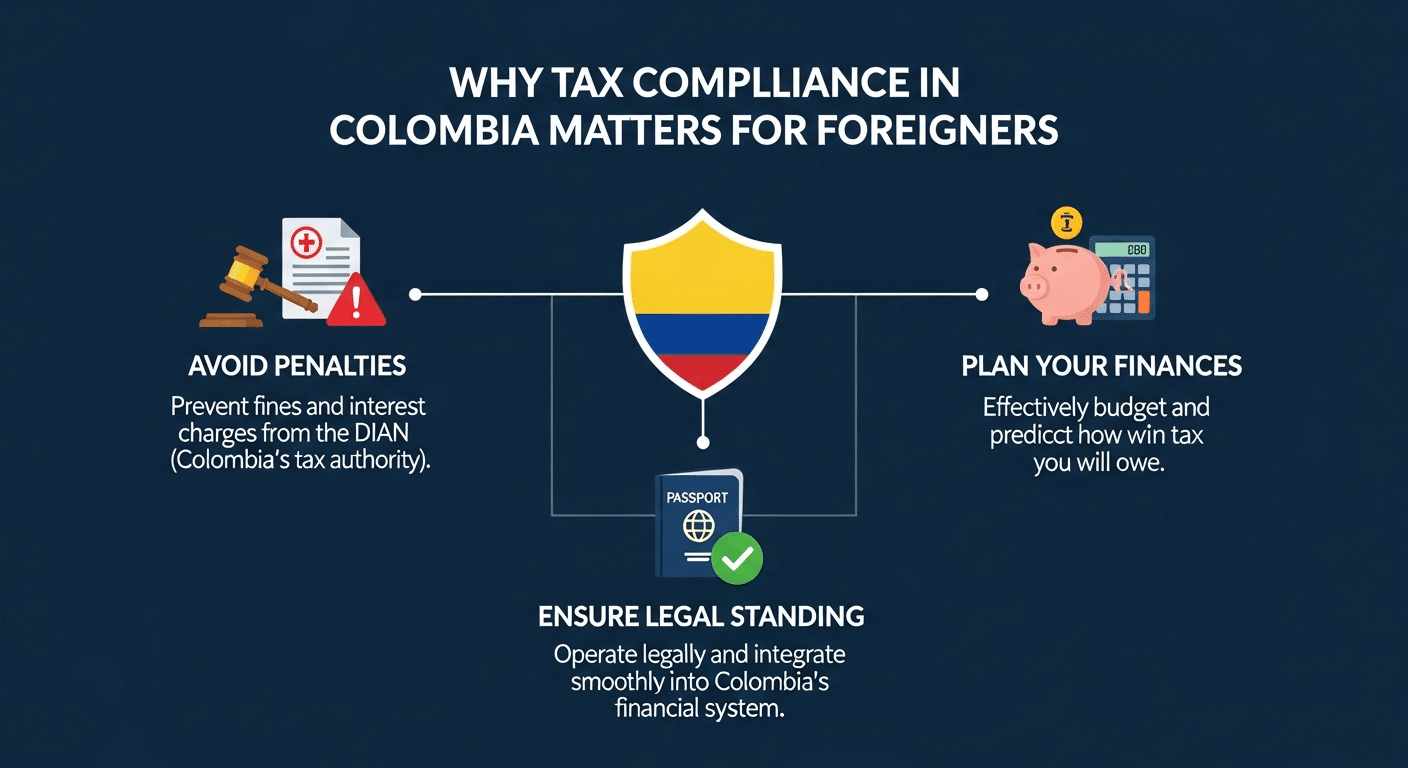
Staying compliant with Colombian tax laws helps you avoid penalties, plan your finances, and secure your legal standing.
Complying with Colombian taxes is not merely a bureaucratic necessity; it’s a fundamental aspect of responsible living and financial planning. As a foreigner residing in Colombia, understanding your tax obligations is crucial for several reasons. Firstly, it prevents potential legal and financial repercussions, such as fines and interest penalties, from the DIAN (Dirección de Impuestos y Aduanas Nacionales), Colombia’s tax authority. Secondly, a clear understanding allows you to plan your finances effectively. You can predict how much you will owe and what money you need to set aside. Understanding your resident status dictates your tax liability and the scope of income and assets you must declare.
Furthermore, proper tax filing ensures you are operating legally, fostering a sense of security and enabling smoother integration into Colombia’s financial system. The Colombian tax system has seen recent reforms, emphasizing the need for up-to-date knowledge. For example, Colombia’s comptroller general’s office reported a 17% year-on-year drop in tax revenue during the first six months of 2024, with a tax take of Col$126.63trn (US$31.52bn), which was down by 17% on the same period in 2023. The tax authority (DIAN) has only collected 40% of the tax revenue that was forecast in the 2024 national budget [source: Latin News, 2024]. This underscores the DIAN’s focus on compliance.
Who is This Guide For? (Focus on foreigners, expats, individual taxpayers)
This guide is specifically tailored for foreigners and expats who are living or have financial interests in Colombia. Whether you are a digital nomad, a retiree, an investor, or simply someone who has chosen Colombia as their home, this resource aims to clarify your responsibilities as an individual taxpayer. We understand that many who relocate are unfamiliar with Colombian tax laws, which can differ significantly from their home countries. This article focuses on providing actionable insights for those who need to understand and fulfill their income tax declaration requirements, distinguishing between residents and non-residents and the unique tax scenarios each group might face. This article gives useful advice for people who need to know and meet their income tax filing duties. It explains the differences between residents and non-residents and the special tax situations each group may have.
Your Key Partners: The DIAN (Dirección de Impuestos y Aduanas Nacionales) and the Declaración de Renta
The primary entity responsible for administering and enforcing tax laws in Colombia is the DIAN (Dirección de Impuestos y Aduanas Nacionales). Understanding its role is paramount. The DIAN is the Colombian tax and customs authority, overseeing the collection of taxes, customs duties, and other national revenues. For individual taxpayers, the most significant interaction with the DIAN involves filing the Declaración de Renta, which translates to the Income Tax Return. This annual declaration is the mechanism through which individuals report their income, expenses, assets, and liabilities to the government. For foreigners, accurately completing this declaration based on their tax residency status is a critical tax obligation.
The DIAN takes non-compliance seriously. Failing to file your Declaración de Renta on time, submitting an incomplete or wrong return, or not paying taxes can lead to big penalties. These include fines, often a percentage of unpaid tax or a fixed amount, plus interest on owed taxes. DIAN can also audit and investigate, causing bigger financial and legal problems. For example, Colombia’s total tax collection was 18,668,382.743 COP mn in October 2025 [source: CEIC], illustrating the significant revenue the government aims to collect. The country also ranks 36th on the 2025 International Tax Competitiveness Index, showing a strong tax system [source: Tax Foundation, 2025]. DIAN provides forms and online platforms for submission and enforces compliance, imposing penalties for violations.
Understanding Your Colombian Tax Residency Status
Determining your tax residency is the most critical first step in understanding your tax obligations in Colombia. Your residency status dictates whether you are taxed on your worldwide income or only on income generated within Colombia. This distinction significantly impacts your tax liability and the scope of your declaration. The Colombian tax authority, the DIAN, has specific criteria for defining who is considered a tax resident. This foundational understanding is key before delving into any filing requirements.

The Critical 183-Day Rule for Determining Tax Residency
The primary determinant for establishing tax residency in Colombia is the 183-day rule. If you remain in Colombia for 183 days or more within any given 365-day period, whether consecutively or cumulatively, you are generally considered a tax resident. This period does not need to fall within a single calendar year; it can span across two years. For example, if you arrive in Colombia on July 1st, 2024, and stay until March 31st, 2025, you will be there more than 183 days. You will be a tax resident for the second part of that time. You will also be a tax resident for all of 2025.
However, it’s important to note that other factors can also influence residency status, such as having your permanent home or primary economic interests in Colombia. Colombia uses the 183-day rule to determine tax residency: staying 183 days or more in any 365-day period makes you a tax resident. This period can span two years. For example, staying from July 1, 2024, to March 31, 2025, counts as residency for 2025. Other factors like having a permanent home, family, or economic ties in Colombia also affect residency status.
Implications of Your Tax Residency for Your Tax Liability
The implications of your tax residency status on your tax liability are profound. As a Colombian tax resident, you are subject to tax on your worldwide income. This means that all income earned from any source, whether within Colombia or abroad, must be reported to the DIAN. This includes salaries, business profits, investment returns, pensions, rental income, and more. Consequently, your tax liability is calculated based on your total global income.
Conversely, non-residents in Colombia are only taxed on their Colombian-sourced income. This typically includes income derived from services performed within Colombia, from Colombian companies, or from assets located in the country. Income earned and assets held entirely outside of Colombia are generally not subject to Colombian income tax for non-residents. Understanding this distinction is paramount for accurate declaration and compliance, as it directly influences the scope of your tax declaration.
Essential Pre-Filing Steps: Getting Your Affairs in Order
Before you can even begin to tackle the intricacies of the Declaración de Renta, there are essential administrative steps that every foreigner in Colombia must complete. These foundational tasks ensure you are properly registered with the tax authorities and have the necessary documentation to file your taxes accurately. Getting your affairs in order proactively simplifies the entire tax filing process and helps avoid last-minute scrambles.
Obtaining Your RUT (Registro Único Tributario) and NIT Number
The RUT (Registro Único Tributario), or Unique Tax Registry, is the identification number assigned to all individuals and entities that are taxpayers in Colombia. This number, also known as your NIT Number (Número de Identificación Tributaria), is essential for virtually all financial and legal transactions within the country, including filing tax returns. If you are working, opening a bank account, or engaging in any economic activity in Colombia, you will need a RUT. Foreigners can obtain their RUT from the DIAN or through authorized entities. It is imperative to ensure your RUT is up-to-date and accurately reflects your personal information and taxpayer status, as it is the primary identifier used by the DIAN.
Gathering All Necessary Financial Documentation
Accurate tax filing hinges on comprehensive and organized documentation. As a foreigner in Colombia, this means gathering financial records from both your Colombian activities and any relevant international financial dealings. This includes, but is not limited to:
- Income Statements: Pay stubs, invoices for freelance work, rental income statements, dividend vouchers, and any other documentation proving income earned in the tax year, denominated in Colombian pesos (COP) where applicable, or foreign currency with conversion details.
- Bank Statements: For both Colombian and foreign bank accounts, especially if you are a tax resident, detailing transactions that may affect your taxable income.
- Investment Records: Proof of ownership and value of stocks, bonds, mutual funds, and other investments. This is crucial for calculating capital gains and income from capital.
- Property Records: Deeds, purchase agreements, and valuations for any real estate owned in Colombia or abroad, which are relevant for property tax and potential capital gains.
- Loan and Debt Documentation: Information on any loans or debts, which may be relevant for deductions.


What Income and Assets to Declare: A Foreigner’s Perspective
Understanding what constitutes reportable income and assets is central to fulfilling your tax obligations as a foreigner in Colombia. The specific requirements depend heavily on whether you are classified as a tax resident or a non-resident. For Colombian tax residents, this typically involves a comprehensive declaration of worldwide income and assets.
Understanding Taxable Income Sources for Foreigners in Colombia
Taxable income in Colombia encompasses a broad range of earnings. For individual taxpayers, this commonly includes:
- Employment Income: Salaries, wages, bonuses, and benefits received from an employer in Colombia or from remote work for foreign companies while residing in Colombia.
- Self-Employment and Business Income: Profits generated from freelance work, independent contracts, or your own business operations within Colombia. This falls under the general income basket.
- Rental Income: Revenue from leasing out properties located in Colombia.
- Investment Income: Dividends, interest, and capital gains from Colombian investments. This also contributes to your capital income.
- Pensions: For tax residents, pensions received from any source, including foreign governments or private institutions, are typically taxable. The tax treatment of foreign pensions can be complex and may involve treaty provisions.
- Occasional Gains: Income from sources not considered habitual, such as lottery winnings or certain property sales, which may be subject to the Impuesto de Ganancias Ocasionales.
Declaring Foreign Income and Assets (for Colombian Tax Residents)
As mentioned, Colombian tax residents are obligated to declare their worldwide income and assets. This means any income earned outside of Colombia—from salaries, investments, rental properties, or businesses abroad—must be reported to the DIAN. Similarly, all assets held internationally, such as foreign bank accounts, overseas real estate, or investments in foreign companies, must be declared. This comprehensive reporting requirement aims to ensure that the Colombian tax system accounts for the total economic capacity of its tax residents. Failing to declare foreign income or assets can lead to significant penalties and legal issues.
Understanding Assets Declaration, Wealth Tax, and Property Tax
In addition to income tax, Colombian tax residents may also be subject to taxes on their assets. The declaration of assets is a critical component of the Declaración de Renta. This includes all movable and immovable property, financial holdings, and investments.
Colombia also has a wealth tax (Impuesto al Patrimonio) which applies to individuals whose net worth exceeds a certain threshold. For 2025, the wealth tax applies to those with a net worth equal to or greater than 72,000 UVT, which is approximately COP 3.585 billion, considering that one UVT in 2025 is COP 49,799 [source: expatgroup]. The specific rates and applicability can vary by year.
Furthermore, local property tax (Impuesto Predial) is levied by municipal governments on real estate holdings within their jurisdiction. While this is a municipal tax, it’s an important consideration for property owners in Colombia.
Demystifying the Declaración de Renta (Formulario 210): Your Step-by-Step Filing Process
The Declaración de Renta, specifically Formulario 210, is the cornerstone of individual tax filing in Colombia. Navigating this form can seem daunting, but understanding its structure and the requirements for each section can simplify the process. This form is used for filing renta personas naturales (natural persons’ income).
Accessing and Navigating the DIAN Online Portal
The DIAN operates a comprehensive online portal that serves as the primary platform for tax filings, payments, and managing your tax affairs. To file your Declaración de Renta, you will need to register and create an account on the DIAN’s website. The portal allows you to download tax forms, complete them electronically, submit them, and make tax payments. It’s crucial to have your digital certificate or secure login credentials ready. The DIAN’s website also provides resources, FAQs, and support to assist taxpayers.
Understanding the Structure and Sections of Formulario 210
Formulario 210 is divided into several key sections designed to capture different aspects of your financial life:
- Identification Data: Personal details, RUT, and tax year.
- Income Baskets: This is where you declare your earnings, categorized into different types (employment, business, capital, dividends, etc.). The classification of income is crucial for determining the correct tax rates and deductions. This forms the basis of your taxable income.
- Deductions and Allowances: Here, you can claim eligible expenses that reduce your taxable income. These might include certain health insurance premiums, education expenses, and interest on specific loans.
- Exempt Income: Certain types of income may be exempt from taxation and need to be declared in this section.
- Assets and Liabilities: A detailed listing of all your assets (property, investments, etc.) and liabilities as of December 31 of the tax year, essential for calculating net worth and potential wealth tax.
- Tax Calculation: This section involves applying the relevant tax rates to your declared income and calculating your final tax liability, considering any applicable credits.
Key Concepts for Foreigners: Income Baskets, Deductions, and Exemptions
For foreigners, understanding specific concepts within Formulario 210 is vital. Income baskets are critical; for instance, income from personal services (salaries) is treated differently than income from capital (dividends, interest) or occasional gains. Deductions allow you to reduce your taxable income by subtracting specific, legally permitted expenses. Common deductions for individuals include payments for health plans, educational expenses, and interest on mortgage loans for primary residences. Exemptions apply to certain income types that are not taxed at all. It’s important to consult with a tax advisor to ensure you are correctly identifying and claiming all eligible deductions and exemptions, especially for foreign income.
Calculating Your Tax Liability and Applying Colombian Tax Rates
After declaring your income, deductions, and exemptions, you will calculate your final tax liability. Colombian tax rates for individuals are progressive, meaning higher earners pay a larger percentage of their income in taxes. The general personal income tax rate in Colombia can reach up to 35% for 2024 [source: Nexo Legal]. Specific rates apply to different income types, such as capital gains or dividends. For example, the Capital Gains Tax rate on occasional gains might differ from the standard income tax rate. Understanding these rates and how they apply to your specific income sources is crucial for an accurate calculation. The DIAN provides tax tables and instructions to assist with this process, often using the Unidad de Valor Tributario (UVT) as a reference for thresholds.
Special Considerations for Specific Foreigner Scenarios
Navigating Colombian taxes as a foreigner often involves unique situations that require specific attention. These can range from international tax agreements to the taxation of particular types of income.
Leveraging Double Taxation Treaties and International Treaties
Colombia has entered into various double taxation treaties and other international treaties with numerous countries. These agreements are designed to prevent individuals and companies from being taxed twice on the same income in two different jurisdictions, and to facilitate cooperation between tax authorities. As a foreigner, understanding if a tax treaty exists between Colombia and your home country can be highly beneficial. These treaties decide which country can tax certain income, like pensions or investment money. They also offer ways to get tax credits or exemptions. This helps lower your total tax bill.
Consulting with a tax advisor knowledgeable in international tax law is essential to effectively leverage these treaties. The Multilateral Instrument also plays a role in modifying bilateral tax treaties to combat base erosion and profit shifting.
Essential Guidance for US Citizens and Green Card Holders
US Citizens and Green Card holders living in Colombia face a unique tax situation due to the United States’ citizenship-based taxation system. This means they are subject to US tax obligations on their worldwide income, regardless of where they live. Therefore, they must file tax returns with both the DIAN in Colombia and the IRS in the United States. The good news is that mechanisms like the Foreign Earned Income Exclusion (FEIE), Foreign Tax Credit, and double taxation treaties can help prevent double taxation.
US citizens may be able to claim the Foreign Earned Income Exclusion on IRS Form 1040 to reduce their US taxable income, and the Foreign Tax Credit using IRS Form 1116 to offset taxes paid to Colombia. Additionally, they might be eligible for the Child Tax Credit. Understanding how these systems interact and how to correctly file in both countries requires careful planning and often professional guidance.
Capital Gains Tax Rate and Impuesto de Ganancias Ocasionales
When you sell an asset (like property, stocks, or businesses) for more than you paid for it, the profit is generally considered a capital gain. In Colombia, these profits may be taxed at the normal income tax rate, or they may be taxed at a special Capital Gains Tax Rate under the Impuesto de Ganancias Ocasionales (Occasional Gains Tax), depending on the nature and holding period of the asset. For tax residents, gains on assets held for more than two years are typically taxed at a lower rate than those held for shorter periods. Non-residents are taxed on capital gains derived from Colombian-source assets. In Colombia, these profits may be taxed at the normal income tax rate, or they may be taxed at a special Capital Gains Tax Rate under the Impuesto de Ganancias Ocasionales. The tax depends on the type of asset and how long you held it.
Other Relevant Taxes for Awareness
While income tax is the most significant annual declaration for individuals, foreigners in Colombia should also be aware of other taxes. The standard IVA (Value-added tax) rate is 19% on most goods and services, with lower rates of 5% for certain items like agricultural equipment and electric/hybrid vehicles, and 0% for basic food products [source: Bright!Tax]. This tax is generally passed on to the consumer. As previously mentioned, property tax (Impuesto Predial) is levied locally on real estate holdings. Additionally, depending on your activities, you might encounter other specific taxes. The Financial Transactions Tax (GMF or Gravamen a los Movimientos Financieros) is levied on certain financial transactions.
Important Filing Dates, Deadlines, and Potential Penalties
Adhering to deadlines is paramount when dealing with any tax authority. The DIAN imposes strict timelines for filing tax returns, and non-compliance can lead to significant penalties.
When to File: Understanding the Filing Dates for Declaración de Renta
The annual Declaración de Renta for individual taxpayers in Colombia typically has a filing window that opens in August and closes in October. However, the exact deadline is determined by the last two digits of your RUT number. The DIAN publishes a calendar each year specifying these staggered filing dates to manage the influx of declarations. It is crucial to identify your specific filing period and submit your declaration within that timeframe. Missing these deadlines can result in penalties.
Consequences of Non-Compliance: Tax Penalties by the DIAN
The DIAN takes non-compliance very seriously. Failing to file your Declaración de Renta on time, filing an incomplete or inaccurate return, or failing to pay taxes owed can result in substantial tax penalties. These penalties can include fines, which are often calculated as a percentage of the unpaid tax or a fixed amount, and interest charges on any outstanding tax debt. The DIAN also has the authority to conduct audits and investigations, which can lead to more significant financial liabilities and legal consequences. For example, Colombia’s total tax collection was 18,668,382.743 COP mn in October 2025 [source: CEIC]. The country ranks 36th on the 2025 International Tax Competitiveness Index, showing a strong tax system [source: Tax Foundation, 2025].
Seeking Professional Assistance: Why an Accountant is Your Best Ally
Navigating the complexities of Colombian tax law, especially for foreigners with international financial interests, can be overwhelming. While this guide provides a comprehensive overview, professional assistance is often invaluable.
The Invaluable Benefits of a Colombian Tax Accountant or Spanish Tax Advisor
A qualified Colombian Tax Accountant or a Spanish Tax Advisor (if you have Spanish connections or need advice on treaties involving Spain) can provide personalized guidance tailored to your specific situation. They possess in-depth knowledge of current tax laws, can help you identify all eligible deductions and tax credits, ensure accurate reporting of foreign income and assets, and advise on the implications of double taxation treaties. Tax experts know the current tax laws well. They help you find all deductions and tax credits you can use. They make sure you report foreign income and assets correctly. They also explain how double taxation treaties affect you.
They can help you avoid common pitfalls, ensure timely filing, and represent you in case of an audit by the DIAN. Ultimately, engaging a professional is an investment that can save you money, prevent costly mistakes, and provide significant peace of mind. They can demystify processes like filling out Formulario 210 and ensure your compliance with all tax requirements. The Colombian tax system is complicated, especially for people with money in other countries. You should get help from a Colombian Tax Accountant. This help is often very important.
Conclusion
Filing your Colombian tax declarations as a foreigner is a manageable process when approached with the right knowledge and preparation. Understanding your tax residency status, primarily through the 183-day rule, is the critical first step, dictating whether your tax liability extends to worldwide income or is limited to Colombian sources. Securing your RUT, meticulously gathering financial documentation, and becoming familiar with the DIAN and its online portal are essential pre-filing actions.
For Colombian tax residents, this means comprehensive reporting of all income and assets, both domestic and international. Non-residents have more limited reporting requirements focused on Colombian-sourced income. Key forms like Formulario 210 require careful attention to detail, especially regarding income baskets, deductions, and exemptions. It’s crucial to be aware of other relevant taxes, such as wealth tax, property tax, and Value-added tax, and to strictly adhere to filing dates to avoid tax penalties.
You must also think about double taxation treaties. You should consider the Capital Gains Tax Rate. There are special rules for some nationalities, like US Citizens. These facts show why you need to make smart choices. Colombian tax law is hard to understand. This is especially true for foreigners with money in other countries. It can be very confusing. For assistance, seeking guidance from a qualified Colombian Tax Accountant or Spanish Tax Advisor is highly recommended. They can help you navigate the complexities, maximize deductions, ensure accurate reporting, and provide peace of mind. They can help you understand complex rules. They can also help you find all deductions you qualify for. They make sure you file your taxes correctly and on time. Understanding your taxes helps you plan your money well. You can predict how much you will owe. You can also see what money you need to set aside.

What Clients Say About Colombia Legal & Associates
⭐️⭐️⭐️⭐️⭐️ 4.7 out of 5.0 based on Google reviews for Colombia Legal & Associates S.A.S.
Public feedback from clients who worked with our legal team on Colombian visa and related legal matters.
Reviews are sourced from publicly available third-party platforms. Individual results may vary.
“I worked with the Medellín team and had an excellent experience. Once I was connected with Isabela, I felt confident I was on the right path to obtaining my visa.”
— Mathew Sickler
“The team helped significantly with my visa process, and everything went much smoother than expected.”
— Mohan Chander Narasimman
“This is the company to use for visa services. My experience was excellent and well organized.”
— Benjamin
“Professional and responsive. They provided clear guidance and helped me understand the process from start to finish.”
— Robert Nepon
“Very professional service. Everything was clearly explained, which helped me avoid delays.”
— Reynaldo Araujo
“Clear communication and realistic expectations. Helpful for someone unfamiliar with Colombian legal procedures.”
— Justin Halladay
Important Legal Disclaimer
The information provided on this website is for general informational purposes only and does not constitute legal advice, immigration advice, tax advice, or a guarantee of any specific outcome.
Colombian laws, visa requirements, administrative criteria, government fees, and procedures change frequently and may be updated without notice. Information published on this site may become outdated or incomplete over time.
Reading or using this website does not create an attorney–client relationship with Colombia Legal & Associates S.A.S., MedellinLawyer.com, or any member of our team.
We strongly recommend consulting directly with qualified legal or accounting professionals regarding your specific immigration, tax, or compliance needs before taking action.
Other Related Services We Offer:

