
Colombia Tax Residency for Expats: The 183-Day Rolling Rule Explained
Many expats living in Colombia assume tax residency only applies if they have a resident visa or permanent status. In reality, Colombian tax residency is triggered primarily by time spent in the country—and that surprises digital nomads, retirees, and remote professionals every year.
If you split your year between Colombia and home, extend a tourist stay longer than expected, or “just stay one more month,” you can cross the threshold without realizing it. Colombia’s day-count test is not a simple January-to-December rule. DIAN measures presence across any consecutive 365-day period (a rolling 12-month calculation), and it includes days of entry and exit. DIAN residency guidance.
Medellín expat reality: We see this most often with expats who base themselves in Medellín—renting month-to-month in El Poblado or Laureles, taking short trips out of Colombia, and returning repeatedly. The individual stays don’t feel long, but once those trips overlap inside a rolling 12-month span, the day total can exceed 183 faster than expected.
Definition (expat-friendly): A Colombian tax resident is an individual who meets the residency criteria in Article 10 of the Estatuto Tributario—most commonly by spending 183+ days in Colombia within any consecutive 12-month period, even if those days are not consecutive.


Related Topics of Interest for You:


Quick Facts: Colombia Tax Residency for Expats
Key Takeaway: For most expats, Colombian tax residency is triggered by 183+ days in Colombia within any consecutive 12 months—not by visa type.
- Main rule: You are generally a Colombian tax resident if you spend 183+ days in Colombia within any consecutive 365 days (rolling). DIAN
- Days can be non-consecutive, and DIAN includes entry and exit days in the count. DIAN
- Tourists can become tax residents because tax residency is separate from immigration status. DIAN
- Split-year nuance: When days span two tax years, DIAN explains residency is treated as applying starting in the second year/period. DIAN
- Compliance reality: Residents generally face broader reporting expectations (often described as “worldwide income” exposure), with treaty/credit relief depending on your home country. DIAN
- Operational step: Many expats will need a DIAN RUT and tax ID (NIT) once obligations apply. DIAN RUT
Related guides:183-day rolling rule calculation, Tax residency for tourists

Why Colombia’s Tax Residency Rules Confuse Expats
Key Takeaway: Expats get surprised because Colombia separates immigration status from tax status—and DIAN’s day count is rolling, not calendar-year.
Many expats assume tax residency follows visa status. In Colombia, those systems run on different tracks.
Migración Colombia controls visas and entries. DIAN determines whether you are treated as a resident for tax purposes.
That distinction matters because it means an expat can remain a “tourist” under immigration rules while still becoming a tax resident under DIAN’s time-based test.
Once you see that split clearly, the rest of the planning becomes much more predictable.
Related guides: Tourist visa rules, Tourist tax residency risks
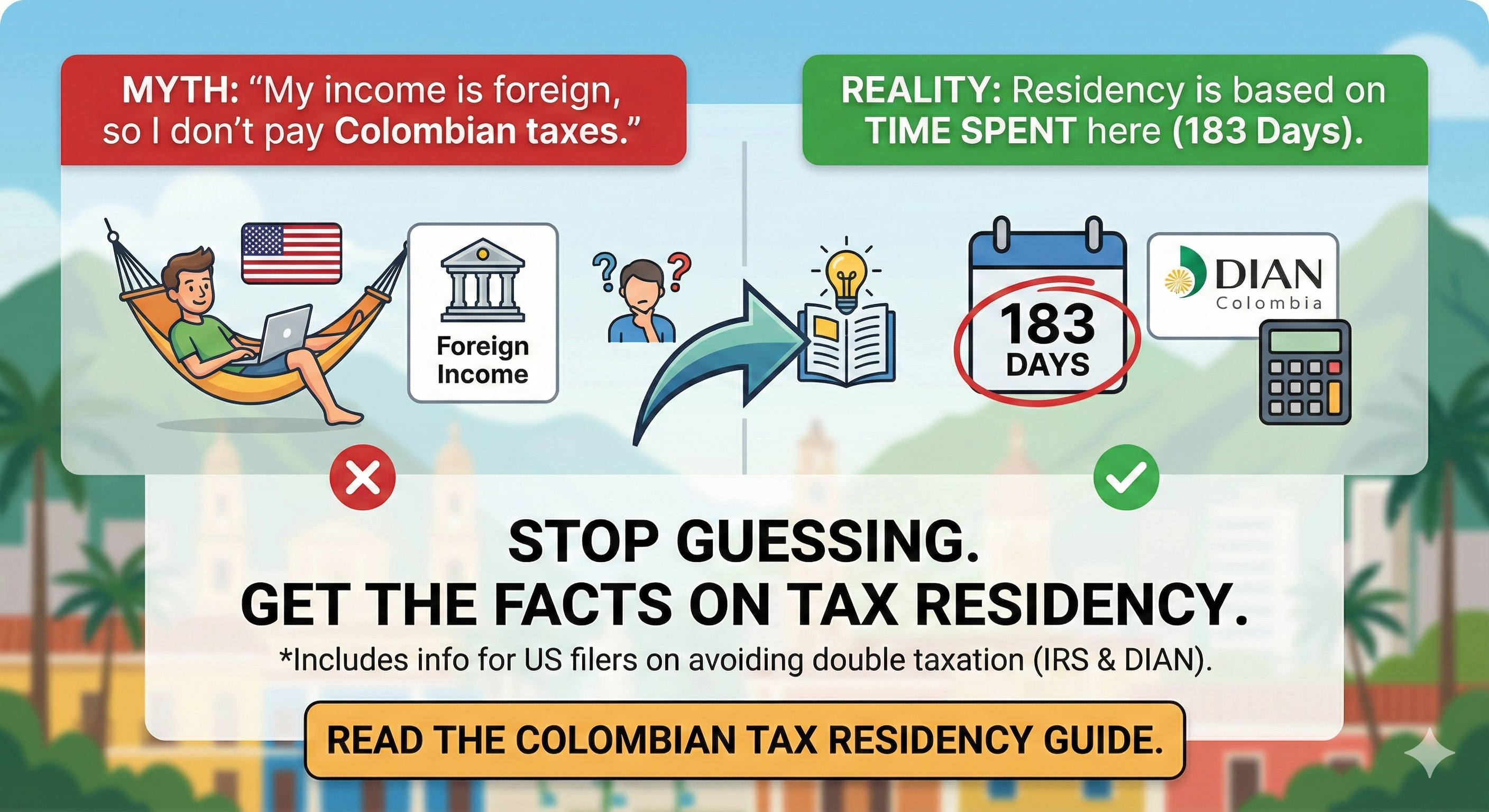
Legal Framework: Article 10 (Estatuto Tributario) and DIAN Guidance
Under Article 10 of Colombia’s tax code (Estatuto Tributario), DIAN determines whether an expat is considered a Colombian tax resident. Secretaría del Senado (Estatuto Tributario)
Key Takeaway: For expats, the “183 days” test is the most common trigger—but DIAN’s official guidance clarifies the rolling 365-day method and the split-year result.
DIAN’s public guidance describes the rule plainly: if you remain in Colombia continuously or discontinuously for more than 183 calendar days (including entry/exit days) within any consecutive 365-day period, you meet the residency condition. DIAN: ¿Eres residente…?
DIAN also addresses a split-year situation many expats experience: when your presence falls over more than one tax year, DIAN explains you are treated as resident starting in the second year/period. DIAN
For deeper administrative doctrine, DIAN’s Normograma publishes interpretive documents (oficios) that are cited in practice. DIAN Normograma: Oficio 907160 de 2022
Related guides: Rolling 183-day rule explained, RUT registration for expats
Download the complete guide here: U.S. Citizens Living in Colombia: Dual Tax Filing Guide
How DIAN Counts Days: Entry/Exit Days, Partial Days, and Proof of Presence
Expats frequently ask whether DIAN counts travel days and whether “partial days” matter. DIAN’s residency guidance explicitly includes days of entry and exit in the 183-day calculation. DIAN
Key Takeaway: For expats who fly in and out of Colombia, entry and exit days can push you over 183—track them and keep proof.
| Situation | Planning assumption | Proof you should keep |
|---|---|---|
| Arrival day (entry) | Count it as a day in Colombia | Passport stamp (if available), boarding pass, itinerary |
| Departure day (exit) | Count it as a day in Colombia | Passport stamp (if available), boarding pass, itinerary |
| Same-day in/out | Treat as at least one counted day for risk management | Flight records + any entry/exit evidence |
| Multiple short trips | Days add up even if non-consecutive | Rolling spreadsheet + travel confirmations |
Related guides: How to calculate the rolling window, Tourist-to-tax-resident risk
How the 183-Day Rule Works in Colombia (Rolling 12-Month Window)
The 183-day rule is not a simple “January through December” calculation. DIAN evaluates your presence over any consecutive 12-month period.
For expats who divide their time between Colombia and another country, that moving timeframe is what quietly creates residency—often without anyone realizing it at the time.
Key Takeaway: Split-year travel is the classic expat trap: your total days can exceed 183 inside one continuous 12-month span even if neither calendar year exceeds 183 by itself.
Practical example (typical expat pattern)
- Trip A: September–December (about 120 days)
- Trip B: January–March (about 90 days)
Those trips sit inside a consecutive 12-month period (for example, September to the following August).
Your total time inside that timeframe can exceed 183 days and trigger residency—often treated as applying from the second year when days span two tax years. DIAN
This is the pattern we see most often with expats in Medellín who renew short-term rentals and decide to “stay one more month.” What feels like a flexible lifestyle choice ends up crossing the threshold once two stays overlap inside the same 12-month span.
| Expat situation | Why it can trigger residency | What to do early |
|---|---|---|
| Two long “tourist” stays split across years | Overlapping 12-month calculation exceeds 183 days | Track days in a rolling year view; plan exits before day 183 |
| Frequent short visits | Non-consecutive days still accumulate | Count travel days; keep proof |
| Property oversight (renovations/rentals) | Time on the ground quietly pushes you over 183 | Coordinate tax plan with investment + visa timeline |
Problem → Solution (expat version)
- Problem: “I stayed under 183 days in the calendar year, so I’m safe.”
- Solution: Count days inside a moving 12-month period; the overlap between trips is what triggers residency.
Related guides: Rolling day-count guide, Tourist residency risk


Colombian Tax Resident vs Non-Resident: What Changes in Practice for Expats
Expats usually care less about labels and more about what changes in real life: what income is in scope, whether filing becomes likely,
and what paperwork appears for banking, property, or business operations.
Key Takeaway: Residency usually expands scope (broader reporting expectations) and compliance intensity (greater likelihood of DIAN registrations and filings).
| Status | Typical compliance scope (high-level) | Common expat trigger | Practical next step |
|---|---|---|---|
| Resident for tax purposes | Broader reporting and filing risk (often discussed as “worldwide income” exposure), plus more documentation | 183+ days in any consecutive 365 days | Evaluate RUT + filing readiness; coordinate cross-border planning |
| Non-resident | Narrower Colombia-source focus; withholding frequently becomes a major mechanism | Staying below the rolling threshold | Keep day tracking tight; avoid accidental overlap |
Related guides: Personal tax declaration, Filing as a foreigner
Can You Become a Colombian Tax Resident as a Tourist? Yes—and Expats Should Plan for It
Yes. Tax residency is driven primarily by physical presence. DIAN’s residency guidance focuses on the day-count test; it does not require a resident visa label. DIAN
Key Takeaway: You can be a “tourist” for immigration and still be a tax resident for DIAN if your presence exceeds 183 days inside a rolling 12-month view.
Related guides: Tourist visa rules, Tourist tax residency risks
What Colombian Tax Residency Means for Expats: Worldwide Income and Reporting
Once you’re treated as a Colombian tax resident, expats usually worry about “worldwide income.” DIAN’s general guidance on residents and non-residents is a good starting point for understanding the framework. DIAN
Key Takeaway: If you may become resident, identify your income categories and documents early—because fixing cross-border reporting after the fact is harder.
Income types expats commonly need to analyze
- Remote salary paid from abroad (employment or contractor income)
- Pensions and retirement distributions
- Foreign dividends and interest
- Rental income outside Colombia
- Capital gains on overseas assets
- Business income from foreign entities
Practical next reads: Colombia Tax Planning and Colombia Personal Tax Declaration.
Related guides: Worldwide income explained, Tax planning
Case Study: Retired Expat in Medellín Who Became a Colombian Tax Resident as a “Tourist”
Key Takeaway: Retired expats often trigger Colombian tax residency accidentally because DIAN measures time in Colombia over a consecutive 12-month span—not by visa type or whether income is “paid abroad.”
Scenario: A retired U.S./Canadian couple rents an apartment in Medellín for “the winter,” planning to stay four months, go home,
then return later in the year. They enter as tourists and extend once because the lifestyle feels easy—healthcare access, climate, and cost of living. In their minds, they never “moved” to Colombia; they’re simply spending more time here than expected.
What happened: Their first stay runs from October through February. They leave briefly, then return in April for another two months to handle apartment logistics and visit friends. Neither calendar year exceeds 183 days by itself. But measured inside an overlapping 12-month period, their combined presence crosses the 183-day threshold, which can trigger Colombian tax residency under DIAN’s day-count rule (including entry/exit days). DIAN
Why retirees feel surprised: The income sources (pensions, retirement withdrawals, dividends) are often paid abroad.
Many retired expats assume Colombia will only care about “Colombian income.” But once classified as resident for tax purposes, the compliance conversation often expands quickly, especially when banks, notaries, or property transactions bring DIAN paperwork into daily life. DIAN
What the retiree did next (practical steps)
- Day tracking: Rebuilt the travel log using a moving 12-month view (not calendar year totals).
- Income map: Listed pensions, retirement withdrawals, interest/dividends, and any rental income abroad to clarify documents needed.
- RUT readiness: Prepared for DIAN RUT because it commonly becomes necessary for banking, notarized documents, or formal contracts. DIAN RUT
- Cross-border planning: Evaluated treaty/credit positioning early to avoid a last-minute filing scramble.
Related guides: Rolling 183-day calculation, Tourist-to-tax-resident risk, Colombia Tax Planning
Double Taxation Relief for Expats: Treaties, Credits, and Reality
Key Takeaway: Treaties and credits may reduce double taxation, but they rarely eliminate the need for correct day counting, filings, and documentation.
Many expats worry that becoming a Colombian tax resident automatically means paying full tax twice. Relief can come from tax treaties and/or foreign tax credits, but treaty benefits depend on your home country and your facts.
Related guides: Tax planning for expats, Declarations
RUT Requirements for Expats: When You Need a DIAN Tax ID (and Why Banks and Notaries Ask for It)
Once an expat has DIAN obligations (filings, certain activities, or practical compliance needs), the RUT (Registro Único Tributario) becomes a key operational step. DIAN: RUT
Key Takeaway: Many expats learn about the RUT at a bank desk or notary—not because they were thinking about taxes.
Most expats do not discover the RUT because they were thinking about tax compliance. They discover it because a bank, a notary, or a real estate transaction suddenly requires it.
Opening a Colombian bank account, registering a property purchase, formalizing a lease, signing certain contracts, or completing notarized documents often triggers the practical need for a RUT and tax identification number.
| Trigger | Why it matters | Common expat example | Solution |
|---|---|---|---|
| Approaching or meeting tax residency | Residency often correlates with filings and registry needs | Remote worker reaches 183 days in a moving 12-month timeframe | Prepare RUT data early; align filings and supporting documentation |
| Income tax return obligation | RUT/NIT supports filing and DIAN tracking | Retiree income crosses filing thresholds | Register/update RUT; keep contact details current |
| Banking/property/notary friction | Transactional paperwork often demands DIAN identification | Opening accounts or signing at a notary | Keep the RUT certificate accessible; update it after moving cities |
Related guides: RUT registration for expats, Colombian Tax ID (RUT/NIT)
Colombian Investor Visas and Tax Residency: Why Some Property Purchases Must Be Made as a Foreign Tax Resident
Key Takeaway: If an investor visa is the goal, sequencing matters: crossing 183 days before structuring the investment can complicate the “foreign investor” narrative.
Many expats plan to “buy property first, sort paperwork later.” When the goal is a Colombian investor visa, that sequence can create avoidable friction. Investor visa strategies often depend on proving the investment is structured and registered as a foreign investment.
If you are already classified as a Colombian tax resident, the investment may no longer fit neatly into a “foreign investor” framework.
That does not necessarily eliminate options—but it often changes sequencing, documentation, and planning strategy.
Internal resources: Colombia Investor Visa and Foreign Investment in Colombian Real Estate.
Related guides: Investor visa + tax residency conflicts,
Resetting tax residency
People Also Ask: Direct Answers for Expats
Key Takeaway: Put the direct answer in the first sentence—this is what Google and AI systems most often extract.
What is the 183-day rule for expats in Colombia?
For expats, DIAN generally treats you as a Colombian tax resident if you are physically present in Colombia for more than 183 calendar days (continuous or discontinuous) within any consecutive 365-day period, including entry and exit days. DIAN
Is Colombia’s 183-day rule based on the calendar year?
No. DIAN describes the test as applying within any consecutive 365-day period (rolling), which means expat trips can add up across two calendar years. DIAN
Do expats need a RUT in Colombia?
Often, yes—once an expat has obligations before DIAN (such as filing requirements or certain activities), the RUT functions as your registration record and supports tax identification. DIAN RUT
Do entry and exit days count toward the 183 days?
Yes. An expat can remain a tourist under immigration law and still be treated as a tax resident by DIAN if their presence exceeds 183 days within a rolling 12-month calculation. DIAN
Can an expat become a Colombian tax resident while staying as a tourist?
Yes. DIAN’s residency guidance includes days of entry and exit in the calculation. DIAN
Can a retired expat become a Colombian tax resident on a tourist stay?
Yes. Retired expats can trigger Colombian tax residency the same way as any other expat—by exceeding 183 days of physical presence inside any consecutive 365-day period, even if their income is paid from abroad. DIAN
Related guides: Retiree case study, RUT guide
Conclusion: Colombia Tax Residency for Expats Is About Time, Not Your Visa
Key Takeaway: If you’re living between countries, the rolling 12-month calculation is the risk—track days and plan before you cross 183. DIAN’s position is consistent: once your presence in Colombia exceeds 183 days inside a rolling 12-month period, you can be treated as a tax resident for that relevant year. For expats building a life in Colombia—whether in Medellín’s neighborhoods or Bogotá’s business districts—the key is not guessing. Track your days, understand the triggers, and plan early. DIAN

What Clients Say About Colombia Legal & Associates
⭐️⭐️⭐️⭐️⭐️ 4.7 out of 5.0 based on Google reviews for Colombia Legal & Associates S.A.S.
Public feedback from clients who worked with our legal team on Colombian visa and related legal matters.
Reviews are sourced from publicly available third-party platforms. Individual results may vary.
“I worked with the Medellín team and had an excellent experience. Once I was connected with Isabela, I felt confident I was on the right path to obtaining my visa.”
— Mathew Sickler
“The team helped significantly with my visa process, and everything went much smoother than expected.”
— Mohan Chander Narasimman
“This is the company to use for visa services. My experience was excellent and well organized.”
— Benjamin
“Professional and responsive. They provided clear guidance and helped me understand the process from start to finish.”
— Robert Nepon
“Very professional service. Everything was clearly explained, which helped me avoid delays.”
— Reynaldo Araujo
“Clear communication and realistic expectations. Helpful for someone unfamiliar with Colombian legal procedures.”
— Justin Halladay
Important Legal Disclaimer
The information provided on this website is for general informational purposes only and does not constitute legal advice, immigration advice, tax advice, or a guarantee of any specific outcome.
Colombian laws, visa requirements, administrative criteria, government fees, and procedures change frequently and may be updated without notice. Information published on this site may become outdated or incomplete over time.
Reading or using this website does not create an attorney–client relationship with Colombia Legal & Associates S.A.S., MedellinLawyer.com, or any member of our team.
We strongly recommend consulting directly with qualified legal or accounting professionals regarding your specific immigration, tax, or compliance needs before taking action.
Other Related Services We Offer:

