
The Complete Guide to Child Custody in Colombia for Expats
📅 Last Updated: March 2026 | Jurisdictions: Medellin, Bogota, Cartagena, National Colombia
Disclaimer: This guide provides critical legal information for foreign nationals under 2026 regulations but does not constitute formal attorney-client advice. Complex Colombia family law and immigration cases require personalized review.
Table of Contents
- 1. Child Custody in Colombia Explained Simply
- 2. Legal Framework & Binding Jurisprudence
- 3. Who Gets Custody? (Expats, Visas, & Rights)
- 4. Child Support (Cuota Alimentaria) Rules
- 5. Institutional Authorities: ICBF, Police & Procuraduría
- 6. Domestic Violence, Psychological Abuse & Emergency Protection
- 7. Step-by-Step Custody Process & Interactive Prep Tool
- 8. Expat Custody Scenarios: Problem & Solution Framework
- 9. Cross-Border Risks & The Dual Citizenship Myth
- 10. Frequently Asked Questions (PAA)
- 11. Master Hub: Patria Potestad vs. Physical Custody Breakdown
- 12. Emergency Strategy: Restablecimiento de Derechos (PARD)
- 13. 2026 Support Calculator: Salario Vital ($1,750,905 COP) Floor
- 14. Visa Cancellation Risks: Res. 5477 & REDAM Defaults
- 15. International Travel: Hague Convention & Airport Exit Permits
- 16. Medellín Jurisdictional Guide: Poblado vs. Alpujarra Hubs
How does Child Custody work in Colombia for
foreigners?
Under Law 1098 of 2006, custody is based on the
“Best Interests of the Child.” For expats, the process is split into two parts:
Potestad
The right to represent the child and decide on
residency/education. Usually shared 50/50.
(Physical Care)
Daily care. Courts now prefer “Custodia Compartida”
(Shared Custody) if both parents reside in Medellin.
Contextual Introduction (The Expat Reality)
Child custody disputes involving foreign parents in Colombia rarely begin as formal legal proceedings. They typically emerge from practical disruptions—relationship breakdowns, relocations between countries, disagreements over schooling, or disputes about international travel. Over time, these situations evolve into legally complex matters involving custody, visitation, financial support, and cross-border compliance. For a broader overview of how these issues fit into the national legal framework, explore our comprehensive pillar guide on Colombian Family Law.
For expats, the primary difficulty is not necessarily the legal standard itself, but the structure and language of the Colombian system. Colombia operates through a multi-layered framework involving administrative authorities, mandatory conciliatory mechanisms, and judicial intervention. Because all proceedings operate 100% in Spanish, securing a bilingual family lawyer or an official translator is practically mandatory to ensure your rights are not lost in translation.


Related Topics of Interest for You:


Child Custody in Colombia Explained Simply
The Colombian system prioritizes the child’s stability, development, and overall best interests. When a marriage ends, navigating how to divorce in Colombia inherently requires settling custody issues first. Decisions regarding children are broken down into three main pillars:
- Custody (Custodia): Where the child lives and who provides daily physical care.
- Parental Authority (Patria Potestad): The legal right and duty of parents to represent their children and make major life decisions (health, education, legal representation).
- Child Support (Cuota Alimentaria): The mandatory financial contribution to the child’s upbringing.
Note: It is highly common in Colombia for one parent to have sole physical custody (Custodia Exclusiva) while both parents retain shared parental authority (Patria Potestad).
Legal Framework & Binding Jurisprudence
The governing law is the Ley 1098 de 2006 (Código de la Infancia y la Adolescencia). This law establishes that children’s rights are prevalent over competing parental interests.
Constitutional Jurisprudence (Binding Interpretation)
The Corte Constitucional has clarified how custody must be applied in recent rulings:
- Sentencia T-255 de 2024: Established that custody decisions must rely on a complete evidentiary analysis of caretaking history, explicitly rejecting traditional gender assumptions.
- Sentencia T-102 de 2023: Reinforced the right of children to maintain consistent, real-world family relationships with both parents.
- Sentencia T-028 de 2023: Confirmed that authorities must guarantee the effective, real-world protection of children’s rights, moving beyond mere administrative paperwork.
Colombia Child Custody, Child Support, and Child Visitation
The Official Document Collection Checklist for Child Visitation, Child Support and Child Custody processes with ICBF, Family Comissaria. This is a general checklist. Individual cases WILL vary, and check list should be verified with your Colombian Family Attorney.
🆔 1. Identifications & Legal Status
- Your Passport & Cedula
Current and valid copies - Ex-Partner’s Colombian ID
Cedula de Ciudadanía copy - Child’s Birth Certificate
Registro Civil de Nacimiento (< 30 days)
💼 2. Parental Financial Capacity
- Bank Statements
Last 3 to 6 months of accounts - Income Proof
Employment contracts or CPA certs - Tax Declarations
Foreign or Colombian tax returns - Asset Proof
Real estate deeds or business ownership
🧾 3. Proof of Payments (The Child’s Needs)
Courts calculate support based on proven historical lifestyle expenses. Gather all physical and digital receipts for:
- 🏫 Education: School tuition, matriculation fees, uniforms, and supplies.
- 🏥 Health & Insurance: EPS contributions, Prepagada, medications, and therapies.
- 🚌 Transportation: School bus contracts, daily transit allowances, or flights.
- 👕 Clothing & Care: Receipts for children’s clothing, shoes, and hygiene.
- 🧸 Recreation & Toys: Extracurriculars, sports clubs, toys, and entertainment.
- 🏠 Housing & Sustenance: Pro-rated rent/mortgage, utilities, and groceries.
⚠️ Expat Alert: Foreign Documents
ANY document originating outside of Colombia (foreign birth/marriage certificates) MUST be officially Apostilled in the country of origin AND translated into Spanish by a licensed Colombian Official Translator. Before bringing foreign documents to Colombia it is best to have a consulation with a licensed Colombian family law attorney.

CRITICAL LEGAL UPDATE (Psychological Abuse & “Alienation”): Expats frequently accuse their ex-partners of manipulating the child against them. However, in late 2023, the Constitutional Court issued Sentencia T-526 de 2023, which officially banned the use of “Parental Alienation Syndrome (SAP)” as a valid psychological diagnosis in Colombian courts.
What this means for you: You cannot simply sue for “alienation.” Instead, your legal team must prove instrumentalization or psychological manipulation of the minor, which Colombian law treats as a severe form of child abuse (maltrato infantil), rather than relying on the banned SAP terminology.
Deprivation of Parental Authority (Privación de la Patria Potestad)
While courts default to shared Patria Potestad, a judge can entirely strip a parent of these legal rights in extreme cases. Grounds for deprivation include severe physical or psychological abuse, total financial and emotional abandonment, or a criminal prison sentence exceeding one year. This is a high legal threshold requiring substantial evidentiary proof.
Who Gets Custody? (Expats, Visas, & Rights)
There is no automatic rule favoring either parent. Whether you are just learning how to get married in Colombia, navigating life on a Colombian Marriage Visa, or you are an unmarried parent, establishing your legal rights early is crucial.
- No Maternal Presumption: The law does not automatically grant custody to the mother.
- Fathers’ Rights: Fathers have an equal legal footing to obtain physical custody if it serves the child’s best interests.
- LGBTQ+ Rights: Colombia has some of the most progressive family laws in Latin America. Same-sex couples enjoy the exact same custody, visitation, and adoption rights as heterosexual couples.
Immigration Strategy Note: If a divorce causes you to lose your spousal visa, you are not forced to leave the country and abandon your child. Expat parents of a Colombian-born child are eligible for the M-Type Visa (Parent of a Colombian National), allowing you to live and work legally in Colombia independently of your ex-spouse.
The Voice of the Child after 12
Under Colombian law, children have a fundamental right to be heard. While a judge will listen to younger children with the help of a psychologist, once a child reaches the age of 12, their preference regarding which parent they want to live with is given substantial, and often decisive, legal weight.
Child Support (Cuota Alimentaria) Rules
In Colombia, you cannot legally settle a custody dispute without also settling child support. It is calculated based on the proven needs of the child and the financial capacity of both parents. By law, child support cannot exceed 50% of the paying parent’s total salary.
Modifying Child Support (Revisión de Cuota)
Expats whose incomes fluctuate—due to currency exchange rate drops or the loss of a remote job—are not permanently locked into an unpayable support order. If you experience a significant change in financial circumstances, you can formally request a modification or reduction (revisión de cuota alimentaria) through a family court.
Institutional Authorities: ICBF, Police, & Procuraduría
Because Colombia uses a multi-layered legal framework, expats must understand exactly which authority handles what step of the process, especially when negotiations fail or turn hostile:
- ICBF (Primary Authority): The Instituto Colombiano de Bienestar Familiar is the frontline administrative body. They handle the mandatory legal conciliations for custody, visitation, and child support before cases ever reach a courtroom.
- Comisarías de Familia: These are local family commissariats that deal with urgent cases of domestic violence or immediate risk to family rights. They can issue rapid emergency protection orders.
- Policía de Infancia y Adolescencia: This specialized branch of the Colombian National Police acts as the absolute first responder. If a child is in immediate, life-threatening danger, or if a parent is violating a legal custody order by attempting to flee with the child, you dial 123 (or the ICBF hotline 141) to dispatch this unit.
- Procuraduría General de la Nación (Ministerio Público): The Procuraduría acts as the supreme watchdog for human rights in Colombia. In highly contentious custody battles, a *Procurador de Familia* (Family Procurator) can be assigned to intervene in court or at the ICBF to guarantee the child’s rights are being respected and that the judge or official is acting legally and without bias.
- Juzgados de Familia (Family Courts): If parents cannot reach an agreement, the case escalates to a Family Judge. They handle formal litigation, enforcement of orders, and complex cross-border disputes.
Domestic Violence, Psychological Abuse & Emergency Protection
Custody disputes can sometimes escalate into physical or severe psychological violence (*Violencia Intrafamiliar*). If an expat is a victim of abuse, or discovers that their child is being subjected to physical, emotional, or sexual abuse by the other parent, standard conciliation is immediately suspended.
How to Obtain a Protection Order (Medida de Protección)
You must take immediate and aggressive legal action. You must file for a Medida de Protección at a local Comisaría de Familia. Under Colombian law (Ley 1257 de 2008 and Ley 2126 de 2021), a Comisario has the power to issue an emergency order within 4 hours if there are signs of imminent danger. These orders can:
- Immediately evict the abusive parent from the family home (even if they own it).
- Issue a strict restraining order preventing the abuser from approaching the victim or the child’s school.
- Temporarily suspend all visitation rights of the abusive parent.
- Grant emergency, provisional sole custody to the safe parent.
The Criminal Route & The PARD Process
Simultaneously, a criminal complaint (denuncia) must be filed with the Fiscalía General de la Nación, as domestic violence is a severe crime in Colombia. Furthermore, if the abuse is directed at the child, the ICBF will initiate a Proceso Administrativo de Restablecimiento de Derechos (PARD), an emergency legal mechanism empowering authorities to immediately remove the child from the dangerous environment.
Urgent: Need Emergency Custody?
If a minor is at risk, you must skip the judge and go to a Comisaria de Familia or ICBF for a "Medida de Restablecimiento de Derechos."
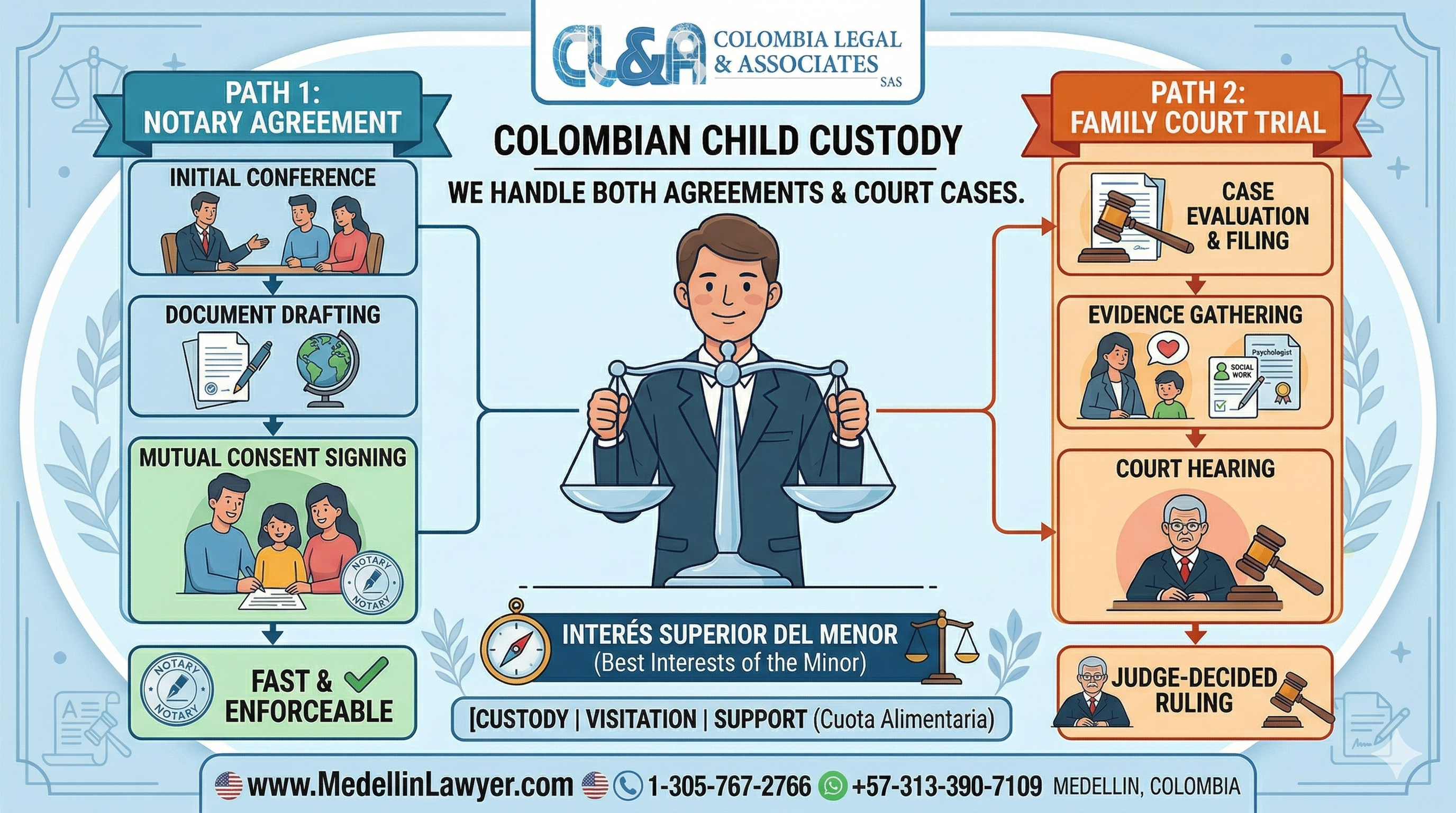
Step 2: If mediation fails, get the "Acta de Conciliacion Fallida."
Step 3: File the formal lawsuit at the Family Court (Palacio de Justicia).


The Step-by-Step Colombia Child Custody Process & Interactive Expat Prep Tools
Unlike some foreign jurisdictions where you can immediately sue your ex-partner in court for custody, Colombia requires a strict procedural order. Below is the exact legal path, followed by two interactive tools to help you assess your travel risks and build your custody case document checklist.
Step 1: Mandatory Conciliation (Requisito de Procedibilidad)
By law, before you can see a judge, you must attempt to resolve the issue through a formal conciliation process. This is usually done before a Defensor de Familia at the ICBF (Instituto Colombiano de Bienestar Familiar) or an authorized conciliation center. The goal is to agree on three things:
- Who has physical custody.
- The exact visitation schedule (Régimen de Visitas).
- Child support (Cuota Alimentaria), including school fees, health insurance, and clothing.
Note: If the other parent fails to show up to the conciliation twice, the ICBF issues a certificate allowing you to proceed to family court.
Step 2: Judicial Escalation (Juzgado de Familia)
If conciliation fails, or if you need a travel permit (Permiso de Salida del País) because the other parent refuses to sign, your lawyer must file a formal lawsuit before a Family Judge.
In Colombia, custody and child support lawsuits are processed through a Proceso Verbal Sumario (Summary Verbal Proceeding). This is designed to be a faster, single-instance process. Critically, during this phase, your lawyer can request Medidas Provisionales (temporary orders) from the judge to establish emergency visitation or child support while the lawsuit is ongoing so the child is not left in limbo.
✈️ Airport Travel Permit Checker for Minors in Colombia
Will Migración Colombia block your child at the airport? Answer the 3 questions below to assess your legal risk instantly.
📋 Colombia Child Custody Case Document Builder
Find out exactly what legal documents and evidence you need to gather before contacting a lawyer or the ICBF.
2026 Child Support Calculator (Alimentos)
If income isn't proven, Colombian law defaults to the Salario Vital ($1,750,905 COP).
| Requirement | 2026 Monthly Baseline |
|---|---|
| Minimum per child (25%) | $437,726 COP |
| Legal Maximum Ceiling | 50% of parent income |
💡 Expert Tactics: How to Negotiate When Things Turn Hostile
Walking into an ICBF conciliation can be highly intimidating, especially when your ex-partner is combative or using the language barrier against you. Keep these strategies in mind to protect your rights:
- Do Not Sign Under Pressure: ICBF officials handle massive caseloads and may pressure you to sign an agreement just to clear the file. You are never legally required to sign an agreement you cannot afford, or that harms your relationship with your child.
- Anchor to Receipts, Not Demands: If your ex-partner demands an arbitrarily high number for child support, counter this by anchoring the negotiation strictly to the documented receipts you brought. Colombian law requires support to be based on proven needs, not lifestyle wishes.
- Walking Away is a Strategic Option: If the other party is entirely unreasonable, refuses visitation, or acts aggressively, allow the conciliation to fail. The official will issue a certificate stating the conciliation was attempted but failed (constancia de no acuerdo). This document is exactly the ticket you need to escalate the case to a formal Family Judge, who will rule based on evidence rather than emotion.
Expat Custody Scenarios: Problem & Solution Framework
Theory is one thing, but how do these laws actually play out for foreigners living in Colombia? Here are real-world examples, including a first-hand account from our own team.
📌 Real-Life Expat Experience: James Lindzey’s Custody Case in Medellin
The Situation: James Lindzey*, originally from Florida, USA, went through a complex divorce and child custody process right here in Medellin, Colombia. After a grueling 1-year of negotiation, they finally reached a mutual agreement. *Yes, that’s right, James Lindzey, our director, personally went through this situation and is happy to share his experience with other expats, so they can learn from him.
The Custody Outcome: They currently share joint custody (custodia compartida). While his daughter lives primarily with her mother, James secured an arrangement in which he has her 2 to 3 nights a week and often sees her up to 4 times a week because they live close by.
The Financial Reality vs. The Agreement: The formal agreement mandated a 50/50 split of expenses for schooling, medical care, food, and lodging. However, the reality has been starkly different: the mother has ultimately not contributed to the lodging, schooling, or food expenses as legally agreed.
This is a real story. Informal agreements—and even formal ones—require strict enforcement mechanisms. Expats in Colombia can book a consultation with James Lindzey to hear real-life stories from expats, learn firsthand what it was like for him to navigate the emotional and legal process, and see how Colombia Legal & Associates handles these exact scenarios. Book a Consultation with James Lindzey
Scenario 2: The Blocked Relocation
The Problem: Maria, a Canadian expat, obtained a lucrative job offer back in Toronto and wanted to relocate with her Colombian-born daughter. The Colombian father, out of spite, refused to sign the exit permit at a notary.
The Legal Solution: Because informal negotiation failed, Maria had to file a lawsuit for a Permiso de Salida del País (Substitute Exit Permission) before a Family Judge. She had to definitively prove that the relocation to Canada offered superior educational and environmental stability for the child. Note: This litigation often takes 1-2 years.
Cross-Border Risks & The Dual Citizenship Myth
The “Dual Citizenship & Embassy Rescue” Myth
Many expats mistakenly believe that if their child holds a US, Canadian, or European passport, Colombian exit rules do not apply, or that their embassy can simply issue a passport and “rescue” them from a custody dispute. This is absolutely false.
Under Colombian law, if a minor holds Colombian nationality (even as a dual citizen), they must enter and exit the country using their Colombian passport. As such, they are fully subject to Migración Colombia’s strict exit permit requirements. Foreign embassies have no legal jurisdiction to override Colombian family law or border controls.
The “Exequatur” Process: Are Foreign Custody Orders Valid?
Another dangerous misconception among expats is that their US, UK, or EU custody agreement will automatically be enforced by Colombian police. Foreign custody orders are not enforceable in Colombia on their own.
International Relocation & Travel Permits
The 30-Day Rule: At Medellin (MDE) airport, Migracion Colombia now requires travel permits to be notarized within 30 days of travel.
To make a foreign custody or divorce decree valid in Colombia, you must undergo this complex legal process called an Exequatur before the Corte Suprema de Justicia. Because this process is highly rigorous and time-consuming, it is frequently faster and cheaper for expats to simply file a brand-new custody lawsuit in a local Colombian family court (like those in Medellin or the expat’s city of residence) if the child is already habitually residing in Colombia.
International Retention & Criminal Penalties (The Hague Convention)
If an expat takes a child out of Colombia on a temporary vacation and refuses to return them, it triggers international abduction laws. Colombia is a strict signatory to the Hague Convention (HCCH), which mandates the prompt return of children to their country of habitual residence.
Where do we file in Medellin?
Frequently Asked Questions (PAA)
Do informal or verbal custody agreements work in Colombia?
No. Many expats rely on verbal agreements, but these are legally unenforceable in Colombia. If a dispute arises, the lack of a formal document legalized through an ICBF conciliation or a Family Judge leaves you highly vulnerable and unable to enforce visitation or support payments.
Do grandparents have visitation rights in Colombia?
Yes. Under Colombian family law, the extended family is strongly protected. The Colombian grandparents have the legal right to sue for their own structured visitation schedule if an expat parent attempts to cut them off without justified legal cause (such as proven abuse).
Can a prenuptial agreement determine child custody in Colombia?
No. Colombian law strictly dictates that child custody and support cannot be pre-determined in a prenuptial agreement. It is decided based solely on the child’s best interests at the time of the separation.
Can I move to another city in Colombia with my child?
While international relocation gets the most attention, domestic relocation can also cause legal trouble. If moving to a new city (e.g., from Medellin to Bogota) functionally breaks the established visitation schedule (régimen de visitas) of the non-custodial parent, it is considered a legal violation. You must formally modify the agreement through conciliation before relocating.
How much does a child custody lawyer cost in Colombia?
Costs vary significantly depending on the route taken. Accompanying a client to a mandatory ICBF conciliation (which takes 1-2 months) is relatively affordable. However, if conciliation fails and full litigation in a Family Court is required (which can take 1 to 2+ years), legal fees generally range from several million COP up to 15+ million COP, depending on the complexity of cross-border assets and international relocation requests.
Conclusion
Child custody in Colombia is a highly structured legal process focused on the child’s welfare, encompassing physical care, financial support, and parental authority. For expats, success depends on abandoning informal agreements, understanding a new legal system, understanding the limits of foreign jurisdiction, aggressively addressing psychological or physical abuse through proper channels, and securing airtight legal documentation to protect your family in the long term.

What Clients Say About Colombia Legal & Associates
⭐️⭐️⭐️⭐️⭐️ 4.7 out of 5.0 based on Google reviews for Colombia Legal & Associates S.A.S.
Public feedback from clients who worked with our legal team on Colombian visa and related legal matters.
Reviews are sourced from publicly available third-party platforms. Individual results may vary.
“I worked with the Medellín team and had an excellent experience. Once I was connected with Isabela, I felt confident I was on the right path to obtaining my visa.”
— Mathew Sickler
“The team helped significantly with my visa process, and everything went much smoother than expected.”
— Mohan Chander Narasimman
“This is the company to use for visa services. My experience was excellent and well organized.”
— Benjamin
“Professional and responsive. They provided clear guidance and helped me understand the process from start to finish.”
— Robert Nepon
“Very professional service. Everything was clearly explained, which helped me avoid delays.”
— Reynaldo Araujo
“Clear communication and realistic expectations. Helpful for someone unfamiliar with Colombian legal procedures.”
— Justin Halladay
Important Legal Disclaimer
The information provided on this website is for general informational purposes only and does not constitute legal advice, immigration advice, tax advice, or a guarantee of any specific outcome.
Colombian laws, visa requirements, administrative criteria, government fees, and procedures change frequently and may be updated without notice. Information published on this site may become outdated or incomplete over time.
Reading or using this website does not create an attorney–client relationship with Colombia Legal & Associates S.A.S., MedellinLawyer.com, or any member of our team.
We strongly recommend consulting directly with qualified legal or accounting professionals regarding your specific immigration, tax, or compliance needs before taking action.


Family matters involving international borders—such as marriage, divorce, or child custody—demand a specialized approach. Our expertise in Colombian Family Law ensures that your rights and those of your loved ones are protected. Often, family status is the primary pathway for obtaining Visas, and we work closely with our immigration department. Whether you are looking for more information on our About Us page or need immediate help, our team is ready.