
Traveling Abroad with Your Child: Legal Consent Requirements in Colombia
Embarking on an international adventure with your child is an exciting prospect, promising new experiences and cherished memories. However, for parents planning to travel abroad with a minor departing from Colombia, this excitement is often tempered by a crucial legal necessity: obtaining proper travel consent. Navigating the specific requirements set by Colombian authorities can seem daunting, but understanding these legal obligations is paramount to a smooth, stress-free journey. This guide will demystify the process, outlining exactly what you need to know, the documents you must prepare, and the legal framework that underpins these requirements. By following this comprehensive, step-by-step approach, you will gain the clarity and confidence needed to ensure your child’s departure from Colombia is legally compliant and successful, safeguarding against potential disruptions at border controls and ensuring your family’s travel plans proceed without a hitch.

Related Topics of Interest for You:


The Excitement and the Obligation: Why Legal Consent Matters
The joy of international travel with children is undeniable, opening up worlds of culture, education, and family bonding. Yet, this privilege comes with a significant responsibility, especially when crossing international borders with a minor. Colombian law, like that of many nations, places a high priority on protecting children from parental abduction and ensuring their welfare. Consequently, robust legal mechanisms are in place to verify that any child departing the country has the express permission of all individuals holding parental authority or legal guardianship. This requirement is not merely bureaucratic; it serves as a critical safeguard. For parents, understanding and adhering to these regulations transforms potential obstacles into manageable steps, ensuring that the anticipation of travel remains focused on the adventure ahead, rather than on the anxieties of legal compliance.
The Focus: Understanding Colombian Requirements for Children Departing the Country
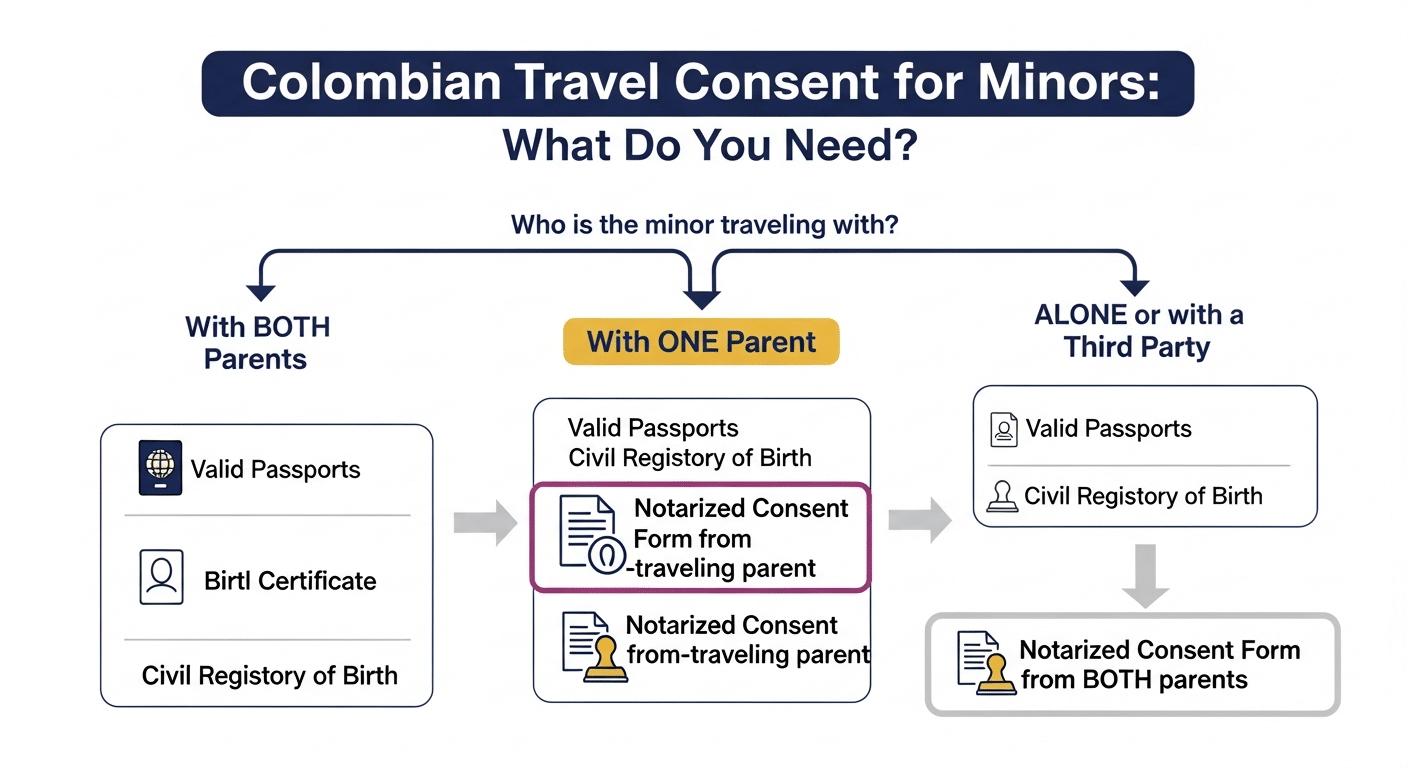
This flowchart outlines the required travel consent documents based on who the minor is traveling with from Colombia.
Colombia enforces stringent regulations concerning the international travel of minors. The primary objective is to prevent child abduction and to ensure that children are traveling with the knowledge and consent of their legal guardians. These requirements apply to all children under the age of 18 who are Colombian nationals or who are departing Colombian territory, regardless of their nationality. Failure to comply can result in significant travel disruptions, including being denied boarding by airlines or prevented from exiting Colombia by immigration authorities. This section clarifies the fundamental expectations of Colombian authorities to help parents prepare adequately.

Consequences of Non-Compliance: Avoiding Travel Delays and Legal Complications
The repercussions of neglecting the proper legal consent procedures for a child traveling abroad from Colombia can be severe and far-reaching. The most immediate consequence is the potential for denied boarding at the airport. Airlines are obligated to verify that all passengers, especially minors, meet the entry and exit requirements of their respective countries. If the required documentation is missing or incomplete, the airline may refuse to allow the child to board the flight, leaving families stranded and their travel plans in disarray. Beyond flight issues, Migración Colombia officials at border controls have the authority to detain or prevent the departure of a minor if the legal consent requirements are not met. This can lead to prolonged questioning, investigations, and potentially even legal proceedings, especially if there are any indications of parental dispute or abduction risk. Furthermore, international travel often involves connecting flights or onward journeys where proof of consent might be re-examined, compounding the initial problem. Therefore, meticulous preparation and adherence to Colombian law are not optional; they are essential to avoid significant stress, financial loss, and legal entanglements.
Understanding Parental Authority and Consent Requirements in Colombia
Colombian law meticulously defines parental authority, ensuring that decisions impacting a child’s welfare, including international travel, are made with the appropriate legal consent. This framework is rooted in the principle of protecting minors.
The Legal Framework: Colombian Family Law and the Protection of Minors
Colombian family law, primarily governed by the Civil Code and specific decrees, places a paramount emphasis on the protection of minors. The state acts as a protector of children’s rights, and this extends to ensuring their safety during international travel. Laws are designed to prevent situations where a child might be taken out of the country against the will of one or both parents, or in circumstances that could compromise their well-being. This legal backdrop necessitates clear, documented consent for any minor departing Colombian territory.
Defining Parental Authority (Patria Potestad) in Colombia
In Colombia, Patria Potestad refers to the set of rights and obligations that parents have towards their minor children. It encompasses responsibilities for the child’s upbringing, education, health, and overall welfare. Crucially, Patria Potestad grants parents the authority to make significant decisions concerning their child, including decisions about international travel. When a child travels abroad, it is understood that they are under the responsibility of a parent or legal guardian, and this authority must be demonstrable to immigration officials. In cases where parents are married or living together, both usually share Patria Potestad. If parents are separated or divorced, Patria Potestad is typically retained by both parents unless a court order specifies otherwise, such as granting sole custody to one parent. This shared authority is why consent from both parents is often a prerequisite for a minor to travel.
When is Travel Consent Legally Required?
Travel consent is legally required for any minor (under 18 years of age) departing Colombian territory, regardless of their nationality. This requirement applies universally to ensure the protection of children. The specific documentation needed varies based on the circumstances of the child’s travel:
- Traveling with Both Parents: While generally smoother, it is still advisable to carry a birth certificate to establish parentage.
- Traveling with One Parent: This is where explicit consent from the non-traveling parent is crucial, usually in the form of a travel consent form or an authorization letter.
- Traveling Alone: The minor must have explicit written consent from both parents or their legal guardian.
- Traveling with a Third Party: If the child is traveling with someone other than a parent (e.g., a grandparent, aunt, uncle, or friend), consent from both parents or guardians is mandatory.
- ¨C22C If one ¨C23C has sole ¨C24C through a ¨C25C, that parent generally has the authority to grant consent, but the ¨C26C itself must be presented as proof.
Who Must Provide Consent?
The rule of thumb in Colombia is that if both parents or legal guardians hold Patria Potestad, both must provide consent for a minor to travel abroad, unless there is a definitive court order that alters this arrangement.
- Both Parents Present: If both parents are traveling with the child, they should carry the child’s birth certificate and potentially their identification to demonstrate parentage.
- One Parent Traveling: The traveling parent must present a notarized travel consent form (known in Colombia as Autorización de Salida del País) signed by the non-traveling parent. This document serves as official authorization.
- Sole Custody: If one parent has been granted sole custody by a Colombian court, they can provide the ¨C43C for the ¨C44C’s travel. However, they must present the official ¨C45C demonstrating this sole ¨C46C status.
- ¨C47C If one ¨C48C is deceased, the surviving ¨C49C can provide consent. A certified copy of the death certificate is required as supporting ¨C50Cation.
- ¨C51C In situations where a ¨C52C is legally declared incompetent, is incarcerated, or refuses to provide consent without just cause, the other ¨C53C or ¨C54C may need to obtain a ¨C55C from a Colombian ¨C56C to authorize the ¨C57C’s travel.
The Essential Colombian Child Travel Consent Document
The cornerstone of legal travel for a minor departing Colombia is the appropriate consent document. This is not a generic international form but often a specific Colombian authorization.
The Purpose and Scope of a Child Travel Consent Form
A Child Travel Consent Form, or its Colombian equivalent, Autorización de Salida del País, serves as a legally binding document. Its purpose is to grant permission for a minor child to travel internationally. This document explicitly states that the parent(s) or legal guardian(s) are aware of and consent to the child’s departure from Colombia, specifying the travel dates, destinations, and accompanying adult(s). It protects the child by providing immigration authorities and airline personnel with clear evidence of parental approval, thereby mitigating risks associated with child abduction or unauthorized travel. The scope of this consent typically covers the duration of the travel outlined in the document.
Key Information to Include in the Consent Letter (Autorización de Salida del País)
To be legally valid and effective, the Autorización de Salida del País must contain specific information. This document must be drafted clearly and comprehensively:
- Full Identification of the Minor: This includes the child’s full legal name, birth certificate number, date of birth, and place of birth.
- Full Identification of the Parent(s) or Legal Guardian(s): This includes their full names, identification numbers (e.g., Colombian cédula de ciudadanía or passport number), and addresses.
- Statement of Consent: A clear declaration that the signatories grant permission for the minor to travel abroad.
- Travel Details: Specific information about the trip, including:
-
- Destinations: The countries the minor will visit.
- Travel Dates: The planned departure date from Colombia and the expected return date.
- Accompanying Adult(s): If the child is not traveling with both parents, the full name and identification of the adult(s) accompanying the child must be listed. If the child is traveling alone, this must be stated.
- Contact Information: Phone numbers and email addresses for the consenting parents or guardians.
- Date and Signature: The document must be dated and signed by the consenting parent or legal guardian.
- Notarization: Critically, the signature(s) must be authenticated by a Colombian Notary Public (Notaría).
The Affidavit of Consent for Travel Abroad (Declaración Juramentada)
In many cases, especially when the travel consent form is not a simple letter but a more formal declaration, it takes the form of an Affidavit of Consent for Travel Abroad, known in Colombia as a Declaración Juramentada. This is a sworn statement made before a Notary Public that attests to the truthfulness of the contents. The Declaración Juramentada carries significant legal weight and is often the preferred document for demonstrating authorization for a child’s international travel. It is a formal document that requires the signatory to swear under oath that the information provided is accurate. This process ensures that the parent understands the gravity of granting permission for a minor to travel internationally.
Language Requirements: Why Spanish is Crucial
All official documentation presented to Colombian authorities, including immigration officials at border controls and Migración Colombia, must be in Spanish. Therefore, the travel consent form or Declaración Juramentada must be written in Spanish. If the document is originally prepared in another language, a certified translation into Spanish will be required. This ensures clarity and avoids any potential misinterpretation by officials tasked with verifying the authorization. This is a non-negotiable aspect of compliance when departing from Colombia.
Avoiding Generic Templates: Tailoring the Document to Colombian Law
While numerous international travel consent templates are available online, it is crucial to use forms specifically designed for or adaptable to Colombian legal requirements. A generic template might omit essential clauses or lack the specific legal wording that Colombian authorities expect. It is highly recommended to consult with a Colombian lawyer or a reputable notary service to ensure the document is correctly drafted and includes all necessary components as per Colombian law. This tailored document will explicitly address Patria Potestad, the minor‘s details, and the specific travel authorization under Colombian legal standards, ensuring it meets the scrutiny of Migración Colombia and other border agencies.
The Colombian Legalization Process: Notarization and International Validity
Once the consent document is prepared, it often requires a formal legal process to ensure its authenticity and acceptance by international authorities. This typically involves notarization and potentially further steps like legalization or an apostille.
Notarization in Colombia: The Role of a Notary Public (Notaría)
The first and most critical step in validating a Colombian travel consent form or Declaración Juramentada is notarization. In Colombia, a Notary Public (Notario) plays a vital role in authenticating signatures and certifying the legality of documents. When a parent or legal guardian signs the travel consent form or Declaración Juramentada in the presence of a Notary Public, the ¨C125C verifies the signatory’s identity against their official identification ¨C126C and attests that the signature is genuine. This process is performed at a Colombian ¨C127C. The ¨C128C will then stamp and sign the ¨C129C, often adding a specific phrase indicating the act performed (e.g., ¨C130C for a deed or a simpler affirmation for a sworn statement). This ¨C131C is a fundamental requirement for the ¨C132C to be considered legally valid by Colombian authorities for international travel.
International Validation: Apostille Certificates vs. Legalization
Once a document is notarized in Colombia, it may need further validation for use in a foreign country. The method of validation depends on whether the destination country is a signatory to the Hague Convention of 1961 Abolishing the Requirement of Legalisation for Foreign Public Documents.
- Apostille Certificates: If the destination country is a member of the Hague Convention, the Colombian document (after notarization) needs to be apostilled. An Apostille is an internationally recognized form of authentication certificate. In Colombia, the Ministry of Foreign Affairs (Cancillería) is responsible for issuing Apostille Certificates. This Apostille verifies the authenticity of the signature and seal of the Colombian Notary Public, making the document valid in all other Hague Convention member countries. This is generally a more streamlined process than traditional legalization.
- ¨C145C If the destination country is ¨C146C a signatory to the Hague Convention, the ¨C147C must go through the traditional ¨C148C process. This is a more complex, multi-step procedure. After ¨C149C by a Colombian ¨C150C, the ¨C151C must be legalized by the Colombian Ministry of Foreign Affairs (¨C152C), and then by the embassy or consulate of the destination country in Colombia. Each step authenticates the previous one, culminating in a document that is recognized by the foreign nation. An ¨C153C may be issued at various stages, depending on the specific country’s requirements.
It is imperative for parents to determine the requirements of their child’s destination country to know whether an Apostille Certificate or full Legalization is necessary.
Specific Colombian Instruments: Escritura Pública and Nota de Vigencia
In certain complex situations or for greater legal weight, a travel consent form might be executed as an Escritura Pública. This is a public deed registered with a Colombian Notary Public. It is a more formal and robust type of document than a simple sworn statement. When an Escritura Pública is used for authorization of travel, it is crucial to obtain a Nota de Vigencia. This is a certification issued by the Notary that confirms the Escritura Pública is still in full legal effect and has not been revoked or altered. A Nota de Vigencia, along with the notarized Escritura Pública, provides the strongest form of ¨C167C and is essential for international travel involving significant legal considerations. For standard travel consent, a ¨C168C is usually sufficient, but understanding these more formal instruments is important for specific scenarios.
Navigating Complex Scenarios Under Colombian Family Law
While straightforward travel consent covers many situations, Colombian family law anticipates more complex circumstances that can affect a minor’s ability to travel abroad.
Sole Custody and Its Impact on Travel Consent
When one parent has been granted sole custody of a minor by a Colombian court, this significantly alters the consent requirements. The parent with sole custody generally possesses the legal authority to grant authorization for the child’s international travel. However, they must be prepared to present the official court order to Migración Colombia or other authorities. This document serves as proof that they hold the exclusive rights and responsibilities for decision-making concerning the child, including travel. It is not uncommon for immigration officials to request this court order in conjunction with the child’s ¨C180C and the traveling parent’s identification.
Deceased Parent: Required Documentation
If one of the child‘s parents is deceased, the surviving parent can typically provide the necessary authorization for the minor to travel abroad. In such cases, the surviving parent must present a certified copy of the deceased parent‘s death certificate as documentation. This official document serves as proof that the deceased parent no longer holds Patria Potestad or parental rights, thus allowing the surviving ¨C192C to act unilaterally in granting consent. This ¨C193C, along with the child’s ¨C194C and the surviving parent’s identification, is essential for a smooth departure.
Parental Refusal or Inability to Provide Consent
Situations can arise where one parent refuses to provide consent for their child to travel, or is unable to do so due to imprisonment, severe illness, or legal declaration of incompetence. In these challenging circumstances, the other parent or legal guardian cannot unilaterally grant authorization. They must petition a Colombian court to obtain a court order that either overrides the refusal or grants the traveling parent the exclusive right to authorize the minor‘s travel. This court order will then serve as the legal basis for the child’s departure, replacing the need for the absent or unwilling parent‘s signature. The process can be complex and requires legal counsel.
Children with Dual Nationality: Specific Considerations for Departing Colombia
For children holding dual nationality, the exit requirements from Colombia are still governed by Colombian law. If a minor is a Colombian national, they must comply with Colombian documentation requirements for departure, regardless of their other nationality. This means that even if a foreign embassy might have different rules for their citizens, Colombia will assess the departure based on its own laws pertaining to Colombian children. Therefore, all necessary Colombian consent forms, notarization, and any required Apostille or Legalization for the destination country must be in order. The child’s Colombian birth certificate and Colombian identification are paramount.
Adopted Children: Special Documentation Requirements Related to Adoption Decrees
When an adopted child travels abroad, the adoption decree issued by a Colombian court serves as the primary legal document establishing the adoptive parents’ rights and responsibilities. This decree effectively replaces the biological birth certificate in demonstrating parentage and Patria Potestad. The adoptive parent(s) named in the decree are the ones who must provide the travel consent form or authorization. In addition to the adoption decree, the child’s identification document and potentially a new birth certificate reflecting the adoption are necessary. The ¨C224Cation should be presented to ¨C225C to confirm the legal relationship between the adoptive ¨C226C and the ¨C227C.
Judicial Declaration of Incompetence for a Parent
If a Colombian court has legally declared a parent incompetent (e.g., due to mental illness or other severe incapacitation), this declaration has profound implications for Patria Potestad. The court order declaring incompetence will specify who will act as the child’s guardian or administrator. In such cases, the designated guardian or the other competent parent will have the authority to provide the necessary authorization for the minor‘s international travel. The court order from the declaration of incompetence is the critical document that must be presented to immigration authorities to bypass the need for consent from the incapacitated parent.
At Colombia’s Borders: What Migración Colombia Expects
Migración Colombia is the primary government agency responsible for managing the entry and exit of people through Colombia’s borders. Their officers are trained to meticulously check all documentation presented by travelers, especially minors.
Understanding Migración Colombia’s Authority at Border Controls and Immigration Points
Migración Colombia officials have the ultimate authority to permit or deny a minor‘s departure from the country. Their role is to ensure that all legal requirements, particularly those related to parental consent and child protection, are met. This includes verifying the authenticity and completeness of all presented documents. They will cross-reference information, examine identification, and confirm that the authorization for travel is valid and issued by the appropriate parties. Airports, such as El Dorado International Airport in Bogotá, are primary points of scrutiny. Officers are vigilant for any discrepancies or missing documentation that could indicate a risk of abduction or unauthorized travel. Understanding their mandate is key to preparing thoroughly.
Essential Documents Checklist for Departing Colombia with a Minor
To ensure a smooth departure from Colombia with a minor, having the correct documentation is critical. While specific requirements can vary slightly based on the destination country and individual circumstances, a general checklist includes:
- For the Minor:
-
- Valid Passport: Ensure it has sufficient validity for the intended travel.
- Colombian Birth Certificate: A certified copy is generally preferred over a simple photocopy.
- Colombian Citizenship Card (Cédula de Ciudadanía), if applicable (for minors over 7 years old).
- For Travel Consent (depending on circumstances):
-
- If traveling with both parents: Both parents’ identification (passports/cédulas) and the child’s birth certificate to prove parentage.
- If traveling with one parent:
-
- The traveling parent’s identification.
- The non-traveling parent’s notarized travel consent form or Declaración Juramentada in Spanish, clearly stating authorization for the specific travel.
- If traveling with a third party:
-
- The child’s birth certificate.
- Notarized travel consent forms or Declaración Juramentada from both parents or legal guardians, naming the accompanying adult and detailing the travel.
- Identification of the accompanying adult.
- If one parent has sole custody:
-
- The court order granting sole custody.
- The traveling parent’s identification.
- If one parent is deceased:
-
- The surviving parent‘s identification.
- A certified copy of the deceased parent‘s death certificate.
- For adopted children:
-
- The adoption decree issued by a Colombian court.
- The adoptive parents’ identification.
- For dual nationals:
-
- Ensure all Colombian requirements are met, including Colombian birth certificate and consent forms.
- For International Validation (if required by destination country):
-
- Apostille Certificate or Legalization affixed to the notarized consent document.
It is always advisable to contact the embassy or consulate of your destination country well in advance of your travel to confirm their specific entry requirements for minors, as these can differ.
What’s Next?
By thoroughly understanding and preparing the necessary legal documentation, you have taken a significant step towards ensuring a legally compliant and stress-free international journey for your child departing Colombia. You have learned about the fundamental principles of Patria Potestad, the specific requirements for travel consent forms and Declaración Juramentada, the crucial role of notary public and the Colombian legalization process, and how to navigate complex scenarios such as sole custody or a deceased parent. You are now equipped to face border controls with confidence, knowing that you have met the stringent expectations of Migración Colombia.
Your next steps should focus on meticulous execution and verification:
- Identify Your Specific Scenario: Determine precisely which of the discussed scenarios applies to your family’s travel plans.
- Draft and Notarize Your Consent Document: Prepare the travel consent form or Declaración Juramentada in Spanish, ensuring all details are accurate. Schedule an appointment with a Colombian Notary Public to have it formally notarized.
- Obtain Necessary Supporting Documents: Gather certified copies of birth certificates, court orders, death certificates, or adoption decrees as required.
- Secure International Validation: Research the requirements of your destination country and obtain an Apostille Certificate or complete the Legalization process if necessary.
- ¨C301C Contact the embassy or consulate of your destination country to confirm their entry requirements for minors and any specific ¨C302Cation they might demand.
- ¨C303C Organize all original and notarized/validated ¨C304Cs in a clear folder for easy access at airports and ¨C305C.
- ¨C306C For complex situations, do not hesitate to seek advice from a Colombian family law attorney.
By proactively addressing these legal requirements, you are not just avoiding potential problems; you are upholding your responsibility as a parent to protect your child and ensuring your international travel experience from Colombia is a positive one.

What Clients Say About Colombia Legal & Associates
⭐️⭐️⭐️⭐️⭐️ 4.7 out of 5.0 based on Google reviews for Colombia Legal & Associates S.A.S.
Public feedback from clients who worked with our legal team on Colombian visa and related legal matters.
Reviews are sourced from publicly available third-party platforms. Individual results may vary.
“I worked with the Medellín team and had an excellent experience. Once I was connected with Isabela, I felt confident I was on the right path to obtaining my visa.”
— Mathew Sickler
“The team helped significantly with my visa process, and everything went much smoother than expected.”
— Mohan Chander Narasimman
“This is the company to use for visa services. My experience was excellent and well organized.”
— Benjamin
“Professional and responsive. They provided clear guidance and helped me understand the process from start to finish.”
— Robert Nepon
“Very professional service. Everything was clearly explained, which helped me avoid delays.”
— Reynaldo Araujo
“Clear communication and realistic expectations. Helpful for someone unfamiliar with Colombian legal procedures.”
— Justin Halladay
Important Legal Disclaimer
The information provided on this website is for general informational purposes only and does not constitute legal advice, immigration advice, tax advice, or a guarantee of any specific outcome.
Colombian laws, visa requirements, administrative criteria, government fees, and procedures change frequently and may be updated without notice. Information published on this site may become outdated or incomplete over time.
Reading or using this website does not create an attorney–client relationship with Colombia Legal & Associates S.A.S., MedellinLawyer.com, or any member of our team.
We strongly recommend consulting directly with qualified legal or accounting professionals regarding your specific immigration, tax, or compliance needs before taking action.
Other Related Services We Offer:

