
How to Divorce in Colombia: Process, Costs, and Cross-Border Guide for Foreigners
Author: James Lindzey
Editorial Review Date: March 26, 2026
Introduction
If you are an expat wondering how to divorce in Colombia, it is important to understand that a divorce in Colombia is the legal process through which a marriage is formally dissolved under national law. While the legal framework is national, the practical experience varies depending on whether the case involves agreement, children, assets, or international elements.
For expats and foreign nationals, navigating this process is rarely a simple administrative step. It often involves coordinating civil records across jurisdictions, structuring Colombian child custody arrangements, defining financial responsibilities, and ensuring that the final outcome is legally valid both in Colombia and abroad.
Many individuals initially search for the fastest way to end their marriage, but quickly realize that the real issue is not just the separation itself. The more important question is how to execute it in a way that protects parental rights, distributes obligations fairly, and avoids future legal conflicts across borders.


Related Topics of Interest for You:


Quick Answer
A divorce in Colombia may proceed through a notary (Notaría) when both spouses agree, or through family court (Juzgado de Familia) when there is disagreement. Following Law 2442 of 2024, one spouse may initiate the dissolution of the marriage without the consent of the other (Divorcio Unilateral).
However, ending the marriage does not automatically resolve issues such as custody (Custodia), child support (Cuota Alimentaria), or property division (Liquidación de la Sociedad Conyugal). These matters must still be addressed through agreement or judicial determination.
- Typical Timeline: A mutual agreement divorce (Divorcio por Mutuo Acuerdo) may take approximately 2–4 weeks once documents are complete. A contested court divorce (Divorcio Contencioso) may take 3–12 months depending on disputes and complexity.
- Typical Cost Structure: Costs vary significantly. Notary divorces are generally lower, while contested cases increase due to litigation, evidence, and hearings.
Key Takeaways
- Divorce in Colombia can be unilateral (Divorcio Unilateral)—no consent required.
- Notary divorce (Divorcio ante Notario) is fastest when full agreement exists.
- Court divorce (Divorcio Judicial) is required for disputes or complex cases.
- Documentation quality determines timeline more than legal arguments.
- Cross-border recognition (Exequátur) is often required for expats.
Legal Framework
The legal basis for divorce in Colombia is established primarily in the Civil Code, specifically Article 154, which outlines the grounds for divorce (Causales de Divorcio). Law 2442 of 2024 introduced a significant reform by adding a unilateral ground based on the sole will of one spouse.
Before this reform, divorce often required mutual agreement or proof of specific grounds. In practice, this allowed one spouse to delay or obstruct the process by refusing to cooperate. The reform reduces that barrier by allowing one party to initiate the dissolution independently.
This does not mean that divorce becomes automatic. Colombian law distinguishes between the dissolution of the marriage and the regulation of its legal consequences. Even when the marriage can be ended unilaterally, issues such as custody, financial obligations, and division of marital property must still be resolved separately.
Essential Spanish Legal Vocabulary for Expats
Navigating a foreign legal system is much easier when you know the terminology. Here are the most important Spanish terms you will encounter during a Colombian divorce:
- Divorcio por Mutuo Acuerdo: Mutual agreement divorce (handled by a Notary).
- Divorcio Contencioso / Unilateral: Contested or unilateral divorce (handled by a Family Judge).
- Causales de Divorcio: Legal grounds for divorce.
- Juzgado de Familia: Family Court.
- Notaría: Notary Public (handles mutual agreements).
- Sociedad Conyugal: The marital estate or community property.
- Liquidación de la Sociedad Conyugal: The legal division and liquidation of marital assets and debts.
- Capitulaciones Matrimoniales: Prenuptial agreements.
- Cuota Alimentaria: Child support or spousal alimony.
- Custodia y Cuidado Personal: Child custody and personal care.
- Régimen de Visitas: Visitation rights/schedule.
- Poder Especial: Special Power of Attorney (used to hire a lawyer to represent you, even if you are out of the country).
- Exequátur: The judicial process required to validate a foreign divorce decree in Colombia.
- Propuesta de Divorcio: The mandatory divorce proposal outlining asset and custody terms under the 2024 Unilateral Divorce law.

The 2024 Unilateral Divorce Reform (Law 2442 of 2024)
On December 27, 2024, the Colombian government enacted Law 2442, fundamentally modernizing the country’s family law by introducing Divorcio Unilateral (Unilateral Divorce). This reform modified several key articles of the Colombian Civil Code, drastically shifting how expats and locals navigate the dissolution of marriage.
Before this law, a spouse could only file for divorce by proving one of the 9 specific fault-based grounds in Article 154 of the Civil Code (such as infidelity, severe alcoholism, abuse, or a de facto separation of more than two years) or by mutual consent. Law 2442 added a 10th ground: “The sole will of either spouse.”
Here is how the new law impacts the process:
1. The Mandatory “Divorce Proposal” (Propuesta de Divorcio)
You cannot simply tell a judge “I want a divorce” and walk away. Under the amended Article 156 of the Civil Code, any unilateral divorce petition must be accompanied by a comprehensive regulatory proposal (Propuesta de Divorcio).
This proposal must legally address:
- Child Support & Custody: Exact amounts, payment methods, and visitation schedules (Régimen de Visitas).
- Asset Liquidation: How the marital estate (Sociedad Conyugal) will be divided.
- Economic Reparations: Any proposed compensation.
The responding spouse has the right to review this proposal and submit a counter-proposal. If the parties cannot agree, the Family Judge will intervene and dictate the final terms based on the evidence provided.
2. New Alimony Protections (Cuota Alimentaria para el Cónyuge)
This is highly relevant for expats who are often the primary earners in a cross-cultural marriage. Law 2442 added a new numeral to Article 411 of the Civil Code, which governs alimony (Cuota Alimentaria).
If you file for a unilateral divorce, and your spouse lacks the financial means to support themselves, the law now explicitly grants them the right to receive alimony. This financial obligation continues until they remarry or enter into a new common-law marriage (Unión Marital de Hecho).
3. The “Court-to-Notary” Fast Track
One of the most practical benefits of the 2024 reform is the ability to de-escalate a legal battle. Under Article 7 of Law 2442, if one spouse initiates a hostile or unilateral divorce through the family courts, but the couple later reaches an amicable agreement, the process does not have to stay in the congested court system. The parties can legally transfer the finalized agreement to a Notary Public (Notaría), converting it into a mutual consent divorce and finalizing it in a matter of weeks.
Fault-Based vs. Unilateral Divorce: Which to Choose?
Even though unilateral divorce is now available, the original fault-based grounds still exist. Why would someone choose the harder route?
- Choose Unilateral (Ground 10): If your goal is simply to end the marriage as efficiently as possible without having to prove your spouse did something wrong.
- Choose Fault-Based (Grounds 1-8): If you are seeking specific financial sanctions, economic damages, or symbolic reparations because your spouse committed a severe breach of the marital contract.


Requirements
To initiate a divorce in Colombia, certain baseline requirements must be met. These include proof of marriage (Registro Civil de Matrimonio), identification of the parties, and documentation supporting any claims related to children, finances, or property.
For foreigners, additional requirements often apply. Documents issued abroad typically require apostille or legalization, as well as certified translation into Spanish. Inconsistent names, missing records, or improperly formatted documents are among the most common causes of delay.
Understanding the requirements early allows the process to move more efficiently and reduces the risk of procedural setbacks.
Colombia Divorce Checklist
- Marriage certificate (recent copy)
- Valid identification (Cédula or Passport)
- Children’s birth certificates (if applicable)
- Financial records
- Property documentation
- Apostille or legalization (foreign documents)
- Certified translations
- Power of attorney (Poder Especial – if remote case)
Which Documents Should You Bring to a Divorce Attorney in Colombia?
The right documents depend on the type of divorce, whether there are children, whether there are assets, and whether any foreign records need to be used in Colombia. This tool gives a practical starting list for organizing your file before a legal consultation.
Documents and Evidence
The documents required depend on the nature of the case. A mutual agreement divorce with no children requires fewer documents than a contested case involving Colombian child custody and assets.
Typical documents include the marriage certificate, identification documents, and financial records. Where children are involved, birth certificates and information regarding living arrangements and expenses are necessary.
In cases involving assets, documentation may include property titles, bank statements, and any existing prenuptial agreement in Colombia (Capitulaciones Matrimoniales), which will heavily dictate how marital property is divided.
The quality and completeness of documentation often determine how smoothly a case progresses. In many cases, delays arise not from legal disputes, but from missing or unusable documents.
Process and Timeline
The divorce process in Colombia begins with identifying the correct legal route. This initial decision determines the structure of the case and the documentation required.
In mutual agreement cases, the process focuses on drafting a comprehensive settlement agreement. This agreement must clearly define custody arrangements, financial responsibilities, and property division. Once submitted, the notary reviews the agreement and, if compliant, formalizes the divorce. In cases involving children, additional review by child protection authorities (ICBF) may be required.
Important: In most cases, timeline depends more on document readiness than legal complexity.
Detailed Procedural Steps in Court-Based Divorce
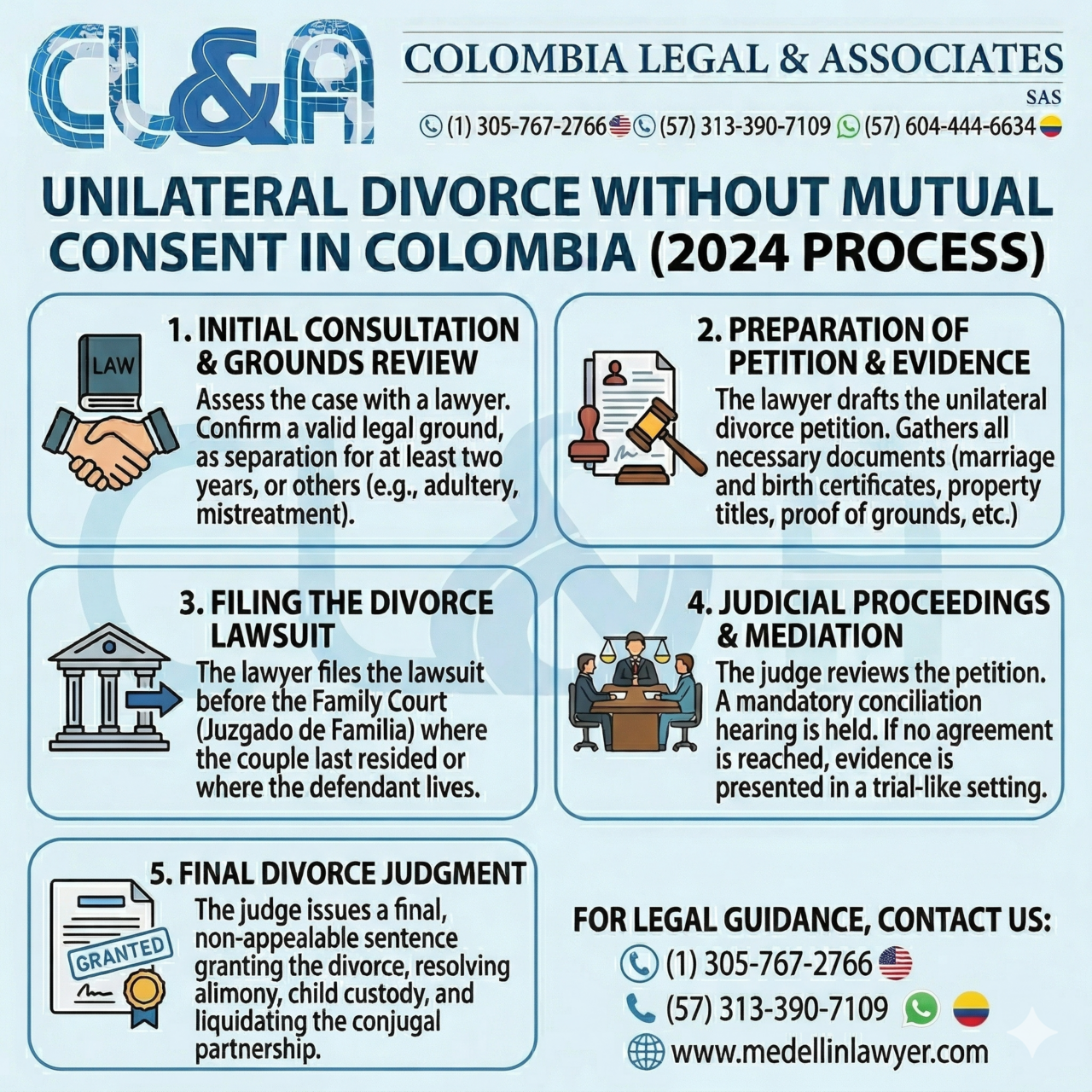
In judicial divorce proceedings (unilateral or contested cases), the process follows a structured sequence that must be completed correctly to avoid delays. After the initial filing, the court reviews the submission to ensure it meets procedural requirements. If accepted, the next step is formal notification to the opposing party, which must be completed according to strict legal standards.
Service of process is a common source of delay, particularly when one party resides abroad. International notification may require additional time and coordination, especially if the receiving country has specific procedural requirements. If notification is not completed properly, the case may be suspended until compliance is achieved.
Once notification is confirmed, the responding party is given an opportunity to reply. This may include accepting the divorce, contesting specific issues, or presenting counterclaims. At this stage, the scope of the dispute becomes clearer.
The evidentiary phase follows. Each party must present documentation supporting their claims regarding income, expenses, custody arrangements, and assets. Courts rely heavily on documentary evidence rather than testimony alone. Inconsistent or incomplete documentation may weaken a party’s position significantly.
In more complex cases, the court may order additional evaluations, including financial assessments or social evaluations related to children. Hearings may be scheduled depending on the level of disagreement. Some cases resolve through partial agreements before reaching a final decision, while others proceed to a judicial ruling that addresses both the dissolution of the marriage and its consequences. Finally, once the divorce is granted, it must be officially registered in the civil registry.
Liquidation of Marital Assets (Liquidación de la Sociedad Conyugal)
A common point of confusion for foreigners is assuming that a divorce decree automatically divides property. In Colombia, dissolving the marriage and liquidating the marital assets (Liquidación de la Sociedad Conyugal) are related but distinct legal steps.
By default, marriages in Colombia operate under a community property regime unless a prenuptial agreement (Capitulaciones) was formalized before the wedding. During liquidation, all assets and debts acquired during the marriage are split 50/50.
Treatment of Foreign Assets: Expats often ask if Colombian courts have jurisdiction over assets held abroad, such as U.S. 401(k) accounts, overseas real estate, or foreign brokerage accounts. While Colombian courts primarily focus on domestic assets, foreign assets acquired during the marriage are technically part of the global marital estate and must be declared. Failing to declare them can lead to legal penalties.
Children, Expenses, and Property
When children are involved, Colombian law prioritizes their best interests. Establishing a fair Colombia child custody agreement for expats is a distinct legal process that must be finalized either through conciliation or a family judge.
Financial responsibilities, including alimony (spousal support) and child support (Cuota Alimentaria), are allocated proportionally based on documented income and caregiving roles.
Practical reality: Courts typically move toward proportional solutions based on documented income and caregiving roles rather than extreme proposals.


What Happens After Divorce in Colombia?
- Divorce must be registered in the civil registry (Registro Civil).
- Civil status must be updated.
- Financial obligations begin.
- Property execution may follow.
- Cross-border recognition may be required.
- Update your estate plans: Following a divorce, it is imperative to update your Colombian Will and Estate Planning documents to reflect your new civil status and reassign beneficiaries.
How Divorce Impacts Your Colombian Visa
If your residency in Colombia is based on a Marriage Visa (Visa M – Cónyuge), the foundation of that visa dissolves with the marriage.
By law, you must notify Migración Colombia and the Ministry of Foreign Affairs of your change in civil status within 30 days of the final divorce decree. Your marriage visa will be canceled, and you will be granted a short grace period (safeguard) to secure a new visa category, such as an Independent Contractor, Investment, or Rentista visa. Failure to report the divorce can result in deportation and future entry bans.
What Most People Get Wrong About Divorce in Colombia
- Thinking divorce itself is the main issue
- Ignoring document requirements
- Assuming international recognition is automatic
- Underestimating financial disputes
- Believing agreement guarantees approval

Risks and Common Mistakes
Most issues arise from preparation errors. Common procedural issues include poor agreements, missing documents, jurisdiction mistakes, and improperly legalized foreign documents.
Beyond procedural errors, certain legal and financial risk factors arise from how parental responsibilities are structured. One common issue is underreporting or misrepresenting income, which may lead to inaccurate support calculations and later disputes.
Another risk involves informal agreements made outside the legal process. While parties may agree privately on certain arrangements, failure to formalize these agreements can make them difficult to enforce later. Courts generally rely on documented and registered agreements rather than informal understandings.
In cases involving shared assets, lack of clarity regarding ownership can lead to prolonged disputes. Assets held in different jurisdictions or under different legal structures may require additional steps to properly identify and divide. For expats, currency differences, international income sources, and tax exposure may create additional complexity. These factors are often overlooked early in the process but can become significant later.
Parental conflict can also escalate when expectations are not aligned. Disagreements over child custody for expats schedules, education decisions, or relocation may extend beyond the initial divorce process if not clearly addressed.
Risk is not limited to losing a specific claim. In many cases, the greater risk is prolonged litigation, increased costs, and unstable long-term arrangements. Addressing these issues early through documentation and clear structuring reduces the likelihood of escalation.
Cross-Border Considerations
Divorce may involve multiple jurisdictions. Recognition through Exequátur may be required. A common mistake is assuming divorce applies internationally automatically. In cross-border cases, the key question is where the result must be legally recognized.
In cross-border cases, recognition is only one part of the process; enforcement of decisions across jurisdictions presents additional challenges. Even when a divorce is recognized, enforcement of financial obligations or custody arrangements may depend on the laws of the other country.
For example, a child custody arrangement for expats established in Colombia may need to be validated separately in another jurisdiction before it can be enforced. Similarly, financial obligations such as child support may require additional procedures to ensure compliance across borders. Differences in legal systems can also create complications. Some countries may not recognize certain aspects of Colombian divorce decisions automatically, particularly where legal standards differ.
Timing is another factor. Initiating proceedings in multiple jurisdictions simultaneously may create conflicts or duplication. Coordinating the process carefully helps avoid inconsistent outcomes.
For individuals with ties to both Colombia and the United States (or Europe), considerations may include immigration status, residency requirements, and the recognition of civil status changes. These factors should be evaluated before deciding where to initiate or recognize a divorce. Addressing cross-border issues early allows for a more coherent legal strategy and reduces the risk of conflicting outcomes across jurisdictions.
Jurisprudence and Judicial Reasoning
Colombian courts emphasize fairness, proportionality, and evidence. Decision C-017 of 2019 reinforces these principles, but the courts have consistently emphasized that family law decisions must reflect the specific circumstances of each case. Rather than applying rigid standards, judges evaluate how legal principles operate in practice.
In cases involving financial obligations, courts often adjust proposed arrangements to reflect proportional capacity. This means that even when parties present agreements, judges may modify them if they do not align with fairness or documented evidence.
Judicial reasoning also reflects a preventive approach. Courts aim to establish arrangements that reduce the likelihood of future conflict, particularly in cases involving children. This includes clarifying responsibilities and minimizing ambiguity.
Another consistent theme is the importance of evidence over assertions. Courts give greater weight to documented records than to general claims. This reinforces the importance of preparation in achieving predictable outcomes. Overall, jurisprudence in this area demonstrates a balance between flexibility and structure, allowing courts to adapt legal principles to real-world family situations.
Expat Experiences
[ALL ORIGINAL STORIES PRESERVED]
Practical Strategy
The most effective approach begins with selecting the correct route.
- Where agreement exists → notary
- Where disputes exist → preparation is critical
With over 20 years of experience and hundreds of expat cases handled, documentation—not legal argument—is the main factor affecting outcomes.
Frequently Asked Questions (FAQ)
Core Process Questions
Can I get divorced in Colombia without my spouse’s consent?
Yes, you can get divorced in Colombia without your spouse’s consent. Under Law 2442 of 2024, Colombian law allows unilateral divorce (Divorcio Unilateral), meaning one spouse can request the dissolution of the marriage even if the other refuses. However, issues like custody, child support, and property division must still be resolved separately.
How long does a divorce take in Colombia?
A divorce in Colombia typically takes 2–4 weeks for a mutual notary divorce (Mutuo Acuerdo) and 3–12 months for a court divorce. The exact timeline depends on whether there are disputes, children involved, property issues, and whether documents are properly prepared from the beginning.
How much does a divorce cost in Colombia?
The cost of divorce in Colombia varies depending on complexity. A mutual notary divorce may range from approximately $800 to $2,500 USD, while a contested court divorce can cost significantly more depending on disputes, duration, and legal work required.
Do I need a lawyer for divorce in Colombia?
Yes, in most cases you need a lawyer for divorce in Colombia. Even in mutual agreement divorces handled by a notary, legal representation is typically required to draft the agreement and ensure it complies with Colombian law, especially when children or property are involved.
Can I divorce in Colombia if I was married abroad?
Yes, you can divorce in Colombia even if you were married abroad. However, the foreign marriage must be properly recognized in Colombia, usually through civil registry registration or validation of the foreign marriage certificate with apostille and translation.
Children & Family Questions
How is child custody decided in Colombia divorce cases?
Child custody (Custodia) in Colombia is decided based on the best interests of the child. Courts evaluate factors such as stability, caregiving history, living conditions, and the ability of each parent to provide support. There is no automatic preference for one parent.
How is child support calculated in Colombia?
Child support (Cuota Alimentaria) in Colombia is calculated based on proportional income and the needs of the child. Courts consider both parents’ financial capacity and living expenses rather than applying a fixed formula.
Can custody be shared in Colombia?
Yes, custody can be shared in Colombia if it is considered in the best interests of the child. Courts may approve shared custody arrangements when both parents are capable and willing to cooperate in raising the child.
What happens if one parent does not pay child support?
If a parent does not pay child support in Colombia, legal enforcement measures can be taken. These may include court orders, wage garnishment, and in serious cases, criminal consequences for non-compliance.
Property & Financial Questions
How is property divided in a divorce in Colombia?
Property in a divorce in Colombia is divided based on the marital estate (Sociedad Conyugal). Assets acquired during the marriage are generally shared, while assets owned before marriage may remain separate if properly documented.
What happens to property owned before marriage?
Property owned before marriage in Colombia is usually considered separate property and not subject to division, unless it was mixed with marital assets or cannot be clearly documented.
Can foreign assets be included in a Colombia divorce?
Yes, foreign assets can be considered in a Colombia divorce for financial evaluation purposes. However, enforcing decisions over assets located abroad may require additional legal action in that country.
Cross-Border & Expat Questions
Can I divorce in Colombia if my spouse lives abroad?
Yes, you can divorce in Colombia even if your spouse lives abroad. The process may require proper international notification and legal procedures, which can add time to the case.
What is exequatur in Colombia divorce cases?
Exequatur (Exequátur) is the legal process used in Colombia to recognize a foreign court decision, including divorce judgments. It is handled by the Supreme Court and is required for the foreign divorce to have legal effect in Colombia.
Will a Colombian divorce be recognized in the United States or Europe?
A Colombian divorce may be recognized in the United States or Europe, but recognition is not automatic. Some countries require additional procedures such as registration or judicial validation.
Can I handle a divorce in Colombia without being present?
Yes, you can handle a divorce in Colombia without being physically present by using a properly executed power of attorney (Poder Especial). This is common in expat cases.
Additional Legal & Procedural Questions
What happens if one spouse cannot be located?
If a spouse cannot be located, the court may allow alternative notification procedures. This process must still meet legal standards to ensure validity.
What if both spouses are foreigners?
Foreign nationals may still divorce in Colombia if jurisdictional requirements are met. However, recognition in their home countries should be evaluated.
Are prenuptial agreements enforceable in Colombia?
Prenuptial agreements may be recognized if they comply with legal requirements and do not violate public policy. Courts may review them in the context of fairness.
Is mediation required before court?
In some cases, mediation or conciliation may be required or encouraged before proceeding to full litigation.
Can one parent relocate with a child after divorce?
Relocation typically requires agreement or court authorization, particularly when it affects custody arrangements or international travel.
Can child support payments be modified later?
Yes. If circumstances change significantly, child support payments may be reviewed and adjusted through a formal legal process.
Additional High-Intent Questions
Can I get divorced online in Colombia?
You cannot fully complete a divorce entirely online in Colombia, but many steps can be handled remotely through legal representation and power of attorney.
Can I remarry immediately after divorce in Colombia?
You can remarry after divorce in Colombia once the divorce is properly registered in the civil registry and your marital status is officially updated.
Does divorce affect immigration status in Colombia?
Divorce can affect immigration status in Colombia if your visa was based on marriage. It is important to review visa options after divorce.

What Clients Say About Colombia Legal & Associates
⭐️⭐️⭐️⭐️⭐️ 4.7 out of 5.0 based on Google reviews for Colombia Legal & Associates S.A.S.
Public feedback from clients who worked with our legal team on Colombian visa and related legal matters.
Reviews are sourced from publicly available third-party platforms. Individual results may vary.
“I worked with the Medellín team and had an excellent experience. Once I was connected with Isabela, I felt confident I was on the right path to obtaining my visa.”
— Mathew Sickler
“The team helped significantly with my visa process, and everything went much smoother than expected.”
— Mohan Chander Narasimman
“This is the company to use for visa services. My experience was excellent and well organized.”
— Benjamin
“Professional and responsive. They provided clear guidance and helped me understand the process from start to finish.”
— Robert Nepon
“Very professional service. Everything was clearly explained, which helped me avoid delays.”
— Reynaldo Araujo
“Clear communication and realistic expectations. Helpful for someone unfamiliar with Colombian legal procedures.”
— Justin Halladay
Important Legal Disclaimer
The information provided on this website is for general informational purposes only and does not constitute legal advice, immigration advice, tax advice, or a guarantee of any specific outcome.
Colombian laws, visa requirements, administrative criteria, government fees, and procedures change frequently and may be updated without notice. Information published on this site may become outdated or incomplete over time.
Reading or using this website does not create an attorney–client relationship with Colombia Legal & Associates S.A.S., MedellinLawyer.com, or any member of our team.
We strongly recommend consulting directly with qualified legal or accounting professionals regarding your specific immigration, tax, or compliance needs before taking action.
Other Related Services We Offer:

Colombian Marriage

Prenuptial Agreements
Child Custody in Colombia